

The recently published UK NFCC Guidelines for Battery Energy Storage Systems (BESS) are “by far the most comprehensive revision we have seen in the UK market to date”.
This is what Mishaal SyedNaveed, product manager for fire safety at system integrator Wärtsilä Energy Storage, says in conversation with Solar energy portal following the publication of the UK National Fire Chief Council (NFCC) fire safety standards for BESS.
The new framework, published in Februaryreplaces the guidelines first issued in 2023.
Revisions have been made following industry engagement and internal processes; The guidelines aim to support fire and rescue services across the country by raising their awareness of BESS projects, enabling effective operational pre-planning and ensuring that their requirements are proportionate to the danger and risk present on site.
“Some of the key differences from the previous edition have been expanded, with much more detailed sections on the permitting phase of planning, with additional scope regarding testing and life cycle,” says SyedNaveed.
He adds that the new regulations are largely based on the US National Fire Protection Association standard, NFPA 855, “with a few caveats”, making it tailored to the UK market. “That is excellent news for everyone, including the public.”
The NFPA 855 guideline for BESS is often referenced worldwide as the standard to be met.
According to SyedNaveed, some of the older requirements were “overbearing” given the amount of research and development (R&D) undertaken by integrators. The old spacing guidelines were his example, as they required greater distance between units, which could be reduced once certain fire tests were performed.
“Distance has been a concern for developers as they try to get as much energy density as possible in the space they are given,” says SyedNaveed.
One of the key changes in the latest version of the UK fire safety regulations for BESS is that the distance between units can be reduced to 0.914 m (3 feet), assuming the unit has passed certain tests, including UL9540A.
“It’s not at the expense of safety, I think this is a very safety-driven document.”
BESS brand news reporting ‘grossly overemphasized’
“Lately, as more and more battery fires make the news, we’re seeing some kind of misinformation about how these fires are behaving. [and] the gases that come out,” says SyedNaveed.
“With the rapid deployment of BESS worldwide, you see a steady trend of battery fires appearing in the news, but it is often far too emphasized. We see gigawatts of energy storage deployments worldwide, but only a handful of incidents. People often forget the ratio; it can be deceptive.”
The most recent and only fire incident at a BESS plant in Britain occurred in February 2025 at Statkraft’s Thurrock project in Essex. The fire at the project under construction was brought under control by local firefighting teams and returned to management less than 24 hours after the response started, and it was put into use in August 2025.
That incident, and the January 2025 fire at the Moss Landing Energy Storage Facility in California, are often cited by energy storage skeptics those who oppose the developments taking place as part of the planning consultation.
SyedNaveed calls the Moss Landing fire “a scenario where there wasn’t a lot of education on how to handle these incidents.” It was a learning moment for the sector and for care providers.
“We are achieving a harmonization of best practices compared to where we were just a few years ago.”
Regulations now outline that “when there is an abnormal scenario [such as a fire] the best recommendation is to let it burn and consume the fuel.”
That said, SyedNaveed also points out that the gases released by battery fires during Wärtsilä’s testing are mainly CO.2largely comparable to the consequences of a house fire.
Proactively test, proactively respond
“Many of these energy storage applications are outdoors, on the ground and in remote areas. So while there is an emergency response procedure in place, there is also site design,” says SyedNaveed.
Fire safety standards have led to what SyedNaveed calls “a shift to large-scale fire testing, where you demonstrate the true worst-case scenario at the site installation level.”
In 2024, Sungrow spent $4.23 million (£3.16 million) in 2024 on what it called the world’s largest and longest fire test. Wärtsilä’s approach uses a proprietary Active Ignition Mitigation System (AIMS) to limit the potential build-up of flammable gas during an abnormal thermal scenario.
Previously, benchmark testing was performed at the cell module and unit level, but this has changed to larger scale testing latest UL9540A fire safety standard. Wärtsilä was well prepared for this because the company, says SyedNaveed, was “very proactive”.
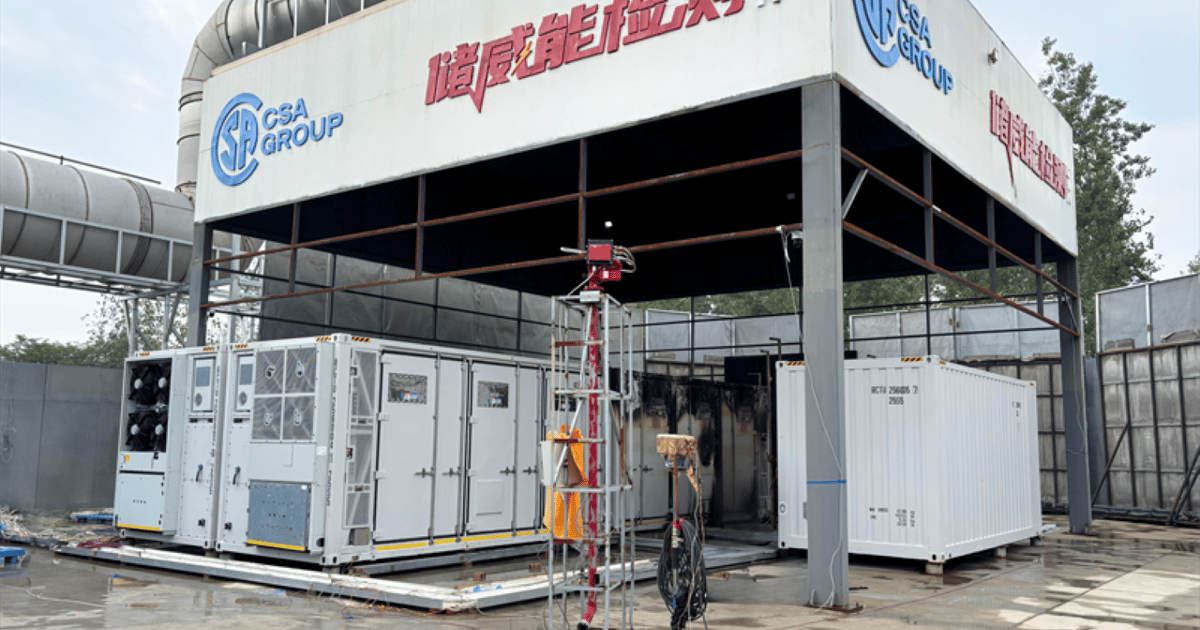
The time had come in November last year conducted benchmark battery tests for its Quantum 3 product with standards development and product testing, inspection and certification company CSA, which completes fire safety testing on three fronts (UL9540A, large-scale fire testing and AIMS testing).
“With demonstrated large-scale fire tests, we show that, in the worst case, the fire does not spread.”
The “smart way to approach this” is to “be proactive and not reactive when these codes and changes occur so you don’t fall behind.”
Proactivity is the best approach “not only when it comes to code changes, but also when it comes to your fire and explosion philosophy; when dealing with these hazards, it’s better to be proactive than reactive,” SyedNaveed adds.
This approach is generally also favored by fire authorities.
“If an abnormal scenario occurs, a proactive response puts less pressure on everyone from site operators to the responding fire department.”
