

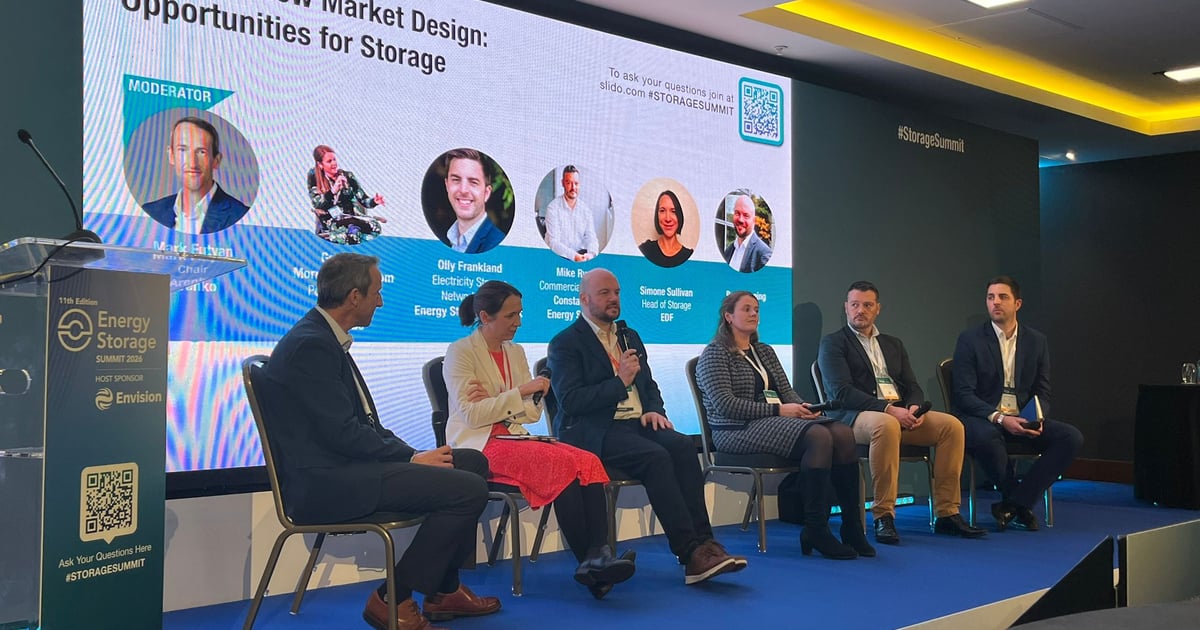
Zenobē received the first Gate 2 Phase 1 connection offer, the company’s public affairs and policy leader Georgina Morris-Rowbottom announced this afternoon at the Energy Storage Summit.
Rowbottom announced the news at a panel entitled ‘The UK’s new market design: opportunities for storage’. She later confirmed that Solar energy portal that the company received the bid for one of its Scottish projects. We reported last week that the first official offer had been made.
Zenobē did not reveal which project is involved, but there are only three major projects underway in Scotland. They are:
-
The 400MW/800MWh Eccles project, under construction
-
The 100MW/200MWh phase two of the Blackhillock project, under construction
-
The 200MW/800MWh Coalburn project in South Lanarkshire, which is reportedly not yet under construction
So it is likely that this is the Coalburn project for which it announced a 15-year toll with Drax last week.
Although there have been several market changes for Britain in the past year, including the conclusion of the review of electricity market arrangements (REMA) and the RIIO-3 network budgeting processthe panel was largely concerned about what moderator Mark Futyan, chairman of Arenko, described as “the trauma of grid reform.”
According to Olly Frankland, head of electricity storage network at industry group Energy Storage Network, delays in the “once in a generation” process of reforming the way projects queue for grid connection have undermined investor confidence and the industry has “fairly low confidence” in the implementation of the reforms.
That said, Frankland did point out that the protection process “worked really well for battery storage in particular,” with the overarching message from the industry being: “Get deals as quickly as possible.”
Paul Manning, director of network analytics company Novogrid, blamed the delays on the National Energy System Operator (NESO) and transmission operators (TOs) being unprepared for the lack of data and data standardization in network processes.
These delays, Manning reiterated, have led to an “erosion of trust.” Frankly, he said his answer should be: “yes, [developers and investors] should concentrate outside Britain”.
One of the driving factors behind grid connection reform was the need to provide developers, and by extension investors, with greater clarity on project construction times.
For Simone Sullivan, head of storage at EDF, “it has been a very frustrating experience” and whether the reforms will actually deliver any clarity or confidence is “still unclear”.
Mike Ryan, commercial director at developer Constantine Energy Storage, said whether or not clarity has been achieved through connectivity reforms depends on an individual’s starting point. He said the most shocking thing about the reform was “how many people in the industry were shocked at the way this has gone”.
“I see it as an abject failure of the industry as a whole, not just the TOs and NESO. We as a development community have known that there was only a finite network capacity and a finite opportunity to build out the network capacity; we knew that TOs have a 20 to 30 year history of being late in delivering; we also know that there has never been a need for the amount of storage that was initially queued.
“If you always expected there would be a fixed connection date, then you have no clarity. If you approached [this process] knowing that there are a lot of smoke and mirrors about what is real or not, feasible or not, and spreading your portfolio to respond to that, then you go through this process with a pretty good feeling. The story you tell your investors determines how you will feel.”
REMA completed, but ‘much needs to be ironed out’
Moving a little further from grid connections, Futyan looks at what was one of the biggest topics of last year. While the industry was largely relieved that they were not faced with the “existential change” that zonal pricing would have brought, “there is still much to be ironed out with a reformed National Pricing (RNP)”.
Rowbottom said that “we are in a very interesting place with RNP”. Although three pillars of (concurrent) work were expected, from the Department for Energy Security and Net Zero (DESNZ), NESO and Ofgem, only NESO has published anything to date.
“The danger we still face now is a siled approach to energy reform, which is really worrying from a battery energy storage perspective. While we disagree that zonal solution is the right solution, we currently do not have the right market signals to allow batteries to function within the constraints of the market.”
Ryan agreed that at least a “clear line on the direction of travel would be good.”
“You can accurately price a known risk, at a lower price than an unknown risk. Certainty is the big opportunity that RMP brings,” he added.
The UK storage investment case
Frankland said that, due to the extensive changes taking place in the UK market, there will likely be “high turnover” and “many projects” that will not reach final investment decision (FID). Hopefully, he said, this will give Britain a more consolidated market.
Sullivan agreed, noting that “no modeling shows that we need the amount of storage required to connect, even until 2050.” She doesn’t expect everything currently in the queue to be expanded, “otherwise it would just cannibalize the market.”
Like her fellow panelists, Sullivan also pointed out the need for the right market signals to enable investments.
Whether these will be implemented in the next phases of reform remains to be seen.
