

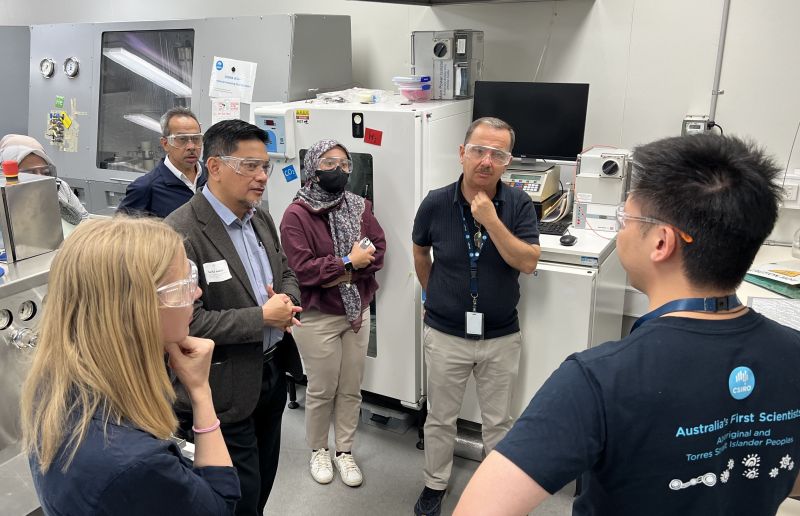
Researchers from Australia’s National Science Agency are working with Malaysian authorities to assess how different battery chemistries perform under tropical conditions, including high temperatures, humidity and corrosion, and how these factors affect durability, safety and cost-effectiveness.
With battery energy storage systems considered a key enabler in the clean energy transition, Australia’s national science agency CSIRO has partnered with Malaysia’s Sustainable Energy Development Authority (SEDA) to investigate how different battery chemistries perform and manage under tropical conditions.
Mahathir Almashor, senior engineer of the CSIRO Energy Systems Program, said much of the global understanding of battery technologies has been developed in cooler climates, resulting in limited data on how heat and humidity affect performance, safety and longevity in tropical environments.
“Most international battery research comes from cooler regions, including Japan, China, Europe and the United States,” Almashor said. “This creates a knowledge gap for countries operating in hot and humid climates. The conditions in Malaysia, combined with SEDA’s strong interest in this topic, made it a natural partner.”
He added that the findings are also highly relevant to northern Australia, which experiences similar tropical conditions.
The joint study assessed six major battery families, such as lithium-ion, sodium-ion, lead-acid, nickel-based, redox flow and molten salt batteries, evaluating their technical performance, commercial viability and sustainability in Malaysia’s tropical climate.
The analysis covered stationary applications ranging from residential and community-scale systems to large commercial and industrial installations.
Almashor said the study identified several factors that affect battery performance in tropical environments, including the effects of high temperatures, humidity and salinity on durability and efficiency, and outlined strategies to mitigate these impacts.
“Consistently high temperatures can accelerate side reactions, leading to shorter lifespans and increased risk of thermal breakout,” he said, noting that Malaysia’s relatively stable temperature range of 22°C to 32°C avoids the deep seasonal swings that can accelerate degradation in colder regions.
High humidity levels, often reaching 80% to 90%, nevertheless pose significant challenges.
“Humidity can accelerate corrosion and contribute to system failures, even when battery-powered energy storage systems are housed in climate-controlled enclosures,” Almashor said. “This risk is further exacerbated by the lack of specific studies examining the effects of humidity and salinity on specific battery chemistries.”
While the study provides a detailed assessment of how tropical conditions affect different battery technologies, the researchers say it does not provide any definitive recommendation. “The optimal solution depends on the application location and the characteristics of the associated renewable energy source,” they said. “It is also sensitive to factors such as duration, scale and cost.”
Almashor said the research lays a foundation for future battery deployment in tropical regions and has relevance beyond Malaysia.
“These insights are relevant not only to Malaysia, but also to Northern Australia, Southeast Asia and the South Pacific, where heat and humidity can significantly impact battery performance, safety and lifespan,” he said.
CSIRO said the study has already attracted interest from other Southeast Asian technical bodies and research partners, reflecting growing regional demand for evidence-based guidance on energy storage in tropical environments.
“There is interest in exploring a second phase of work, where the research could potentially be extended to other Southeast Asian contexts,” Almashor said.
This content is copyrighted and may not be reused. If you would like to collaborate with us and reuse some of our content, please contact: editors@pv-magazine.com.
