

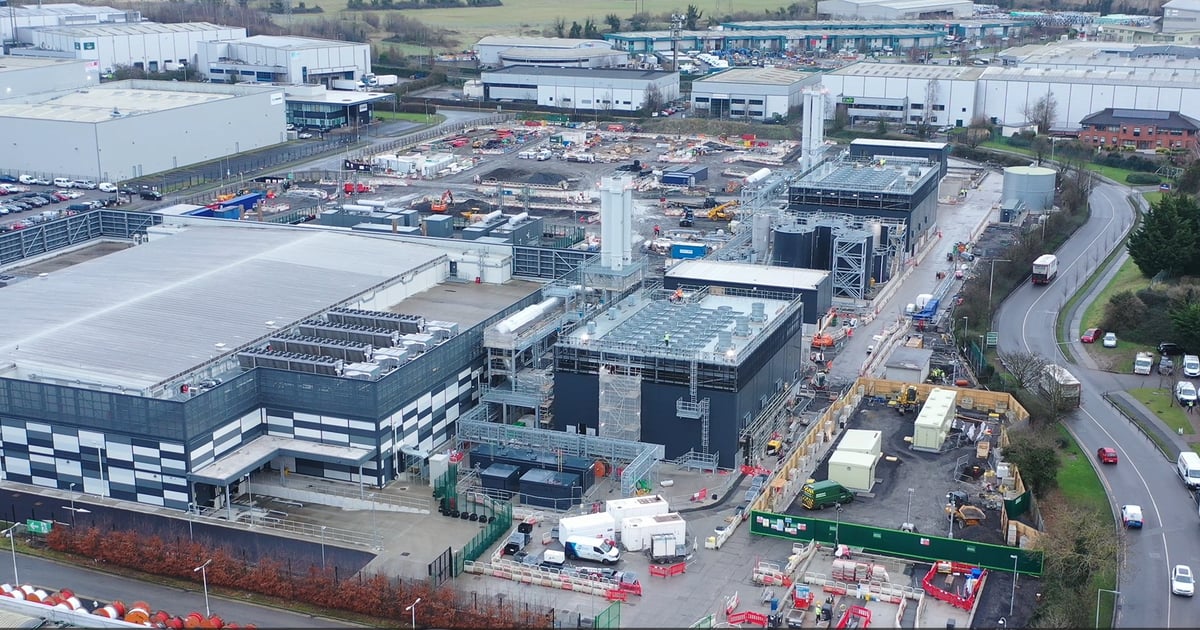
Hyperscale cloud and AI data center operator Pure Data Centers Group (Pure DC) has announced the launch of ‘Europe’s first’ 110MW onsite microgrid to support a data center in Dublin, Ireland.
The microgrid will provide on-site energy generation and integrate a battery energy storage system (BESS) to manage load fluctuations. According to the launch announcement, the BESS – whose capacity was not given – is designed to support the future integration of renewable energy “as part of a broader transition path”.
The 110MW microgrid was developed by AVK, a supplier of standby and switchable energy systems for data centers and AI infrastructure. Located on Pure DC’s Dublin campus, it will provide switchable capacity to support data center operations during initial development, before the site is fully integrated into the electricity grid.
According to the two companies, the campus will ultimately operate as part of a “hybrid energy configuration,” combining electricity from the national grid with on-site infrastructure “designed to increase flexibility, resilience and system stability.”
The successful integration of the microgrid, which allows early operations of the Pure DC data center to commence before it receives a grid connection offer, demonstrates what Pure DC called the “transitional and complementary role” of a microgrid in delivering “strategically important digital infrastructure.”
Planning delays and grid connection shortages have been significant barriers to producers bidding in the Renewable Energy Support Scheme (RESS), Ireland’s answer to the UK government’s Contracts for Difference (CfD) programme. As in Britain, demand connections are slow and difficult to obtain due to a lack of infrastructure.
Implementation and demand of Irish data centers
Interest in Ireland as a future technology hub is a key part of foreign and private investment in the country, and along with Frankfurt, London, Amsterdam and Paris, Dublin is one of the top five cities for data center development (the FLAPD group).
Ireland has been predicted to have this for a few years now highest growth rate in Europe for electricity demand and consumptionwith an average annual increase of almost 7%. Data centers are expected to make a huge contribution, with the country bracing for rapid expansion in this sector.
In 2022, Irish state-owned energy company EirGrid placed a moratorium on new data centers in the Dublin area, which would last until 2028. However, politicians have insisted they have no plans to restrict future developments across the country.
In December, Ireland’s Commission for the Regulation of Utilities announced that data centers could be built to meet at least 80% of their annual energy demand through new renewable electricity sources.
This is evident from figures from the Central Bureau of Statistics of Ireland 21% of Ireland’s measured electricity consumption in 2023 was used by data centresmore than the total amount for urban housing (18%) and for rural housing (10%).
According to Irish grid operator RTE, data centers accounted for 22% of electricity consumption in Ireland in 2024, up from just 5% in 2015. It is estimated that consumption will grow to almost a third of national electricity demand by 2030.
This explosion in demand caused by data centers, which have enormous power needs, has done just that it was said to be soluble through the effective use of renewable energy sources. Major technology companies are compensating for the climate impacts of data center power consumption purchasing electricity through power purchase agreements (PPAs) which also provide consistent long-term income for renewable producers.
Furthermore, the potential of private cable installations and microgrids to generate the necessary energy on site is increasingly a topic of interest within the sustainable energy sector. The role of technologies such as BESS or long-term energy storage (LDES) to support the electricity grid with the demands of data center deployment is also becoming increasingly important.
At Solar Media’s Energy Storage Summit 2026, held last month, data centers were an important topic of discussion.
Data center microgrid powered by gas
The announcement of the launch of microgrids by Pure DC and AVK highlights the importance of microgrids in regions where “grid reinforcement and sustainable generation are being achieved in phases under national planning frameworks”.
However, apart from the BESS component, the microgrid on Pure DC’s Dublin campus does not have renewable energy.
The microgrid consists of three ‘interconnected energy centers’, each with a capacity of up to 30 MW. These generators are all powered by natural gas. The site will also be equipped with a 200 MW thermal gas connection. Some reports state that the data center campus could increase Ireland’s emissions by 1%.
According to Pure DC, the system is designed to accommodate “incremental changes” in fuel composition, “to support the future decarbonisation of the gas network”.
The design includes the option of combined heat and power (CHP), with “infrastructure in place” to enable heat recovery and “potential future connection” to district heating networks. Data centers generate a significant amount of heat, which in some cases is used as an energy source in other applications.
Pure DC said its Dublin microgrid is ready for biofuels, after the company said it was the first in Europe to demonstrate a proof of concept for 100% biomethane-powered data center operations.
The fact that the Dublin microgrid is not powered by the now proven technology is likely due to the race to deploy it. This is despite the additional barriers to implementation that retrofitting entails.
In the proof of concept announcement, Pure DC acknowledged that renewable gas is “a transitional measure rather than a final outcome.” In the short term, it said it is “actively evaluating” Irish biomethane purchase agreements, and in the long term, in line with Irish policy, Pure DC will take measures including the integration of local renewable projects “to further reduce emissions intensity”.
Pure DC is owned by Oakland Capital Management; in October last year, Bloomberg reported that anonymous sources confirmed that Oakland was looking to sell a 20-40% stake in Pure DC at a valuation between £4 billion and £5 billion.
