

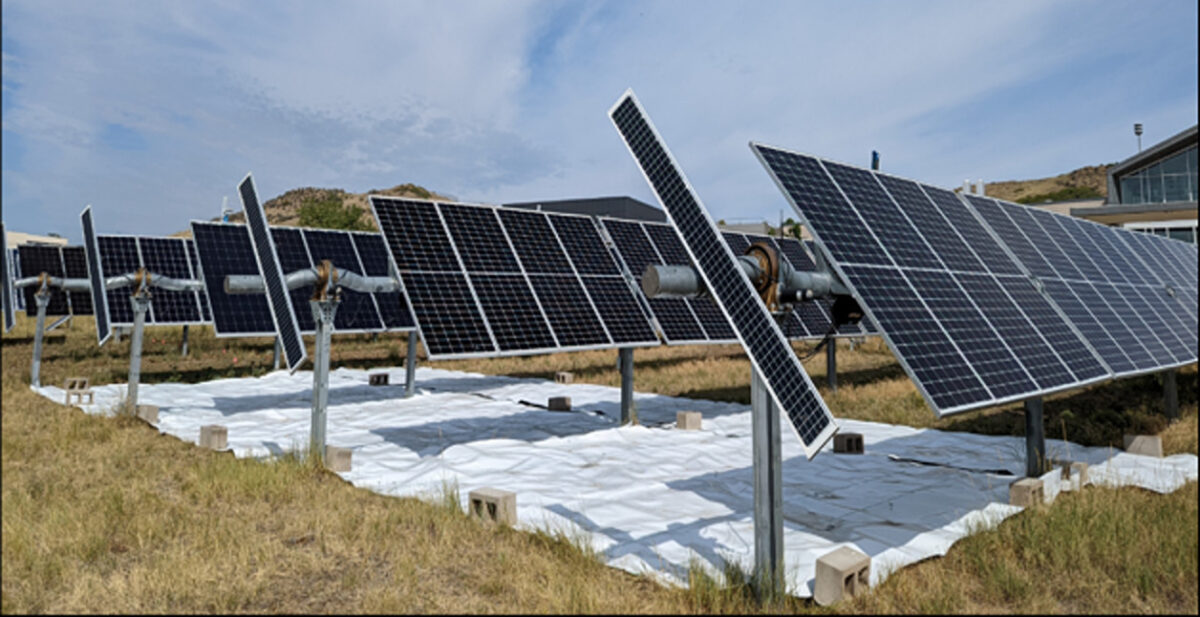
Tests conducted by Canadian researchers at the NREL test field in Colorado have shown that ground reflectors based on high-density polyethylene can significantly improve the performance of bifacial PV installations. They emphasized that the profitability of this technology is strictly dependent on location and warned against combining it with inverter clipping.
Researchers from the University of Ottawa in Canada have investigated the effects of using an artificial ground reflector in large-scale bifacial PV installations and found that it can increase a facility’s power generation by as much as 4.5%.
“It is critical that these reflectors are placed directly beneath the solar panels, and not between rows, to maximize this benefit,” said Mandy Lewis, lead author of the study. “These findings are especially significant in Canada, where snow cover lasts three to four months per year in major cities like Ottawa and Toronto, and 65% of the country’s vast landmass is snow-covered for more than half the year.”
The research team conducted its analysis on a 75 kW bifacial system based on horizontal single-axis tracking (HSAT) and located at a test facility of the U.S. Department of Energy’s National Renewable Energy Laboratory (NREL) in Golden, Colorado. “We studied a single row of PERC+ modules with a bifaciality factor of 70%,” the company explains, noting that the tests were conducted over four months. “Power and weather data at the module level were measured at 1-minute intervals and averaged to the right to obtain 15-minute power values.”
The scientists used an artificial high-albedo, UV-resistant reflector material made of high-density polyethylene (HDPE), supplied by Germany-based Solmax Geosynthetics. The solar-weighted reflectivity reached about 70%. They assessed five different reflector configurations: with 100% ground coverage; 50% and 25% ground cover, both centered on the torque tube; and 50% and 25% ground cover, both centered in the center of the open ground between rows.
The performance of the PV system components that depend on the reflector was compared with that of module rows without a reflector. The modeling presented a root mean square error (RMSE) of 5.4% on an hourly basis and showed an increase in total annual irradiance of 8.6% and an annual energy yield of up to 4.5% when 70% reflective material is added to a single reflective material. axle tracking system. The optimal reflector placement was found to be directly under the torque tube for all reflector sizes.
Further economic analysis also found that reflector technology can deliver break-even installation costs of $2.50–4.60 per m²2. “Higher break-even material costs are possible in systems with a higher initial LCOE. For example, we found breakeven installation costs of $3.40–6.00/m2 for Seattle, Washington, with 60% reflective material,” the academics pointed out.
Furthermore, they emphasized that the profitability of the reflectors is strictly dependent on the location, with solar radiation playing a key role. They also recommended avoiding the use of the reflectors in projects with inverter clipping, which occurs when the DC energy from a PV system exceeds the maximum input size of the inverter. “Inverter clipping has a significant impact on systems that incorporate artificial reflectors, reducing annual energy gains and shifting the ideal placement for the smallest reflectors in some locations,” they warned.
Their experiments are described in the article “Size and position of artificial ground reflectors Effects on energy yield and economics of double-sided single-axis solar photovoltaics,” published in Progress in photovoltaics. “These findings are of particular value to Canada and other generally cloudy countries, as a 6.0% power gain was observed in cloudy Seattle, compared to 2.6% in arid Tucson,” the researchers pointed out.
Another research group at the University of Ottawa recently developed a new technique to measure the energy yield of bifacial PV systems. The new scaled back irradiance (SRI) method reportedly improves IEC measurements by considering the effects of the spectral albedo of different ground covers when calculating the back irradiance of the bifacial system.
This content is copyrighted and may not be reused. If you would like to collaborate with us and reuse some of our content, please contact: editors@pv-magazine.com.
