
Close Menu
  • News
  • Industry
  • Solar Panels
  • Commercial
  • Residential
  • Finance
  • Technology
  • Carbon Credit
  • More
    • Policy
    • Energy Storage
    • Utility
    • Cummunity
What's Hot

Dutch solar owners asked to switch off during peak periods to ease the distribution crisis

June 7, 2026

The hydrogen flow: Toyota demonstrates its racing prototype on liquid hydrogen

June 7, 2026

Era of electrification exposing Australia’s weakest link

June 6, 2026
Facebook X (Twitter) Instagram
Solar Energy News
Monday, June 8
  • News
  • Industry
  • Solar Panels
  • Commercial
  • Residential
  • Finance
  • Technology
  • Carbon Credit
  • More
    • Policy
    • Energy Storage
    • Utility
    • Cummunity
Solar Energy News
Home - News - A new protocol to improve the sustainability of flexible solar technology
News

A new protocol to improve the sustainability of flexible solar technology

solarenergyBy solarenergyDecember 5, 2024No Comments2 Mins Read
Facebook Twitter Pinterest LinkedIn Tumblr Email
Share
Facebook Twitter LinkedIn Pinterest Email


A new protocol to improve the sustainability of flexible solar technology


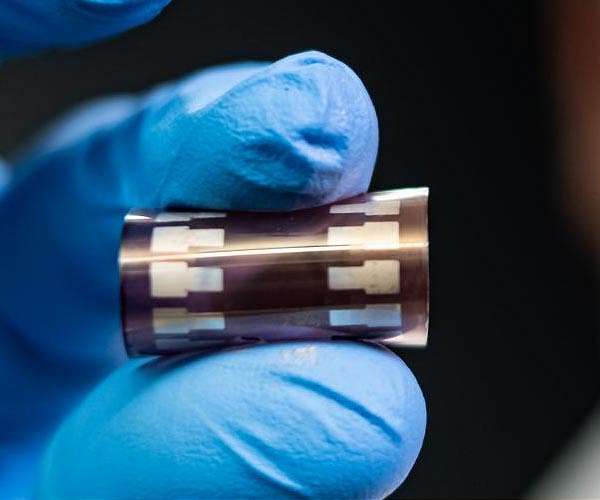
Flexible photovoltaic devices, or FlexPVs, are emerging as key solutions in applications ranging from wearable technology and smart textiles to drones and space systems. Despite significant improvements in efficiency, FlexPVs still face challenges related to the lack of standardized testing protocols for durability and flexibility, hindering their practical application.

In response, the Universitat Rovira i Virgili (URV) led an international team of 23 experts from 12 countries to develop a uniform testing protocol for flexible solar cells and panels. The initiative, published in Nature Energy, focuses on mechanical performance and provides consistent benchmarks for evaluation. “The protocol measures efficiency over 1,000 bending cycles at a strain of 1%, providing a benchmark for mechanical resistance,” explains Lluis F. Marsal, a URV researcher in electronic, electrical and automatic engineering.

This comprehensive method also assesses environmental factors such as humidity and temperature and includes encapsulation techniques to reduce degradation. The protocol ensures that these devices can perform effectively and safely under a wide range of conditions, allowing them to be used in applications that require both flexibility and durability.

The research effort was co-led by Kenjiro Fukuda of the RIKEN Center for Emerging Matter Science in Saitama, Japan, and Osbel Almora, a researcher at URV and administrator of Emerging-PV.org. Marsal, a pioneer in organic solar cell research and leader of the URV Nanoelectronics and Photonic Systems group, also played a crucial role in the project.

Expand the FlexPV potential

Flexible photovoltaic devices differ from rigid panels by using materials that allow adaptation to curved surfaces without significant loss of efficiency. Their lightweight design makes them ideal for drones, smart clothing, wearable medical devices and Internet of Things applications. The mechanical properties of FlexPVs enable resilience under extreme conditions and open doors for use in aerospace and automotive technologies.

See also  Entergy and NextEra Energy Resources enter into agreement for up to 4.5 GW of new solar + storage

This new testing protocol represents the first step toward bridging the gap between solar photovoltaics and flexible electronics. “The advancement of these devices will require new protocols for testing stabilization, torsion and adhesion properties, which will enable the next generation of flexible solar cells to meet future demands,” Marsal concluded.

Research report:A bend test protocol for characterizing the mechanical performance of flexible solar photovoltaics


Source link

flexible improve protocol solar sustainability technology
Share. Facebook Twitter Pinterest LinkedIn Tumblr Email
solarenergy
  • Website

Related Posts

Dutch solar owners asked to switch off during peak periods to ease the distribution crisis

June 7, 2026

Letter from China’s PV Industry: Arctech wins 2.1 GW solar deal

June 5, 2026

ComEd starts a new energy pilot with a solar rebate on the roof of a brewery

June 5, 2026
Leave A Reply Cancel Reply

Don't Miss
Finance

Hungary refinances rebate program for residential solar energy – SPE

By solarenergyJuly 22, 20240

The Hungarian government is investing another HUF 30 billion ($83.9 million) in its HUF 75.8…

BMW, Exolum bet on H2 logistics – SPE

December 3, 2024

US ethanol plant will house a steam-generating heat pump – SPE

September 27, 2024

Gresham House Floor agreements replaced Octopus Tol, Switching Augments on

July 7, 2025
Stay In Touch
  • Facebook
  • Twitter
  • Pinterest
  • Instagram
  • YouTube
  • Vimeo
Our Picks

Dutch solar owners asked to switch off during peak periods to ease the distribution crisis

June 7, 2026

The hydrogen flow: Toyota demonstrates its racing prototype on liquid hydrogen

June 7, 2026

Era of electrification exposing Australia’s weakest link

June 6, 2026

‘Come out from behind your screen, our industry is ultimately about people’

June 6, 2026
Our Picks

Dutch solar owners asked to switch off during peak periods to ease the distribution crisis

June 7, 2026

The hydrogen flow: Toyota demonstrates its racing prototype on liquid hydrogen

June 7, 2026

Era of electrification exposing Australia’s weakest link

June 6, 2026
About
About

Stay updated with the latest in solar energy. Discover innovations, trends, policies, and market insights driving the future of sustainable power worldwide.

Subscribe to Updates

Get the latest creative news and updates about Solar industry directly in your inbox!

Facebook X (Twitter) Instagram Pinterest
  • Contact
  • Privacy Policy
  • Terms & Conditions
© 2026 Tsolarenergynews.co - All rights reserved.

Type above and press Enter to search. Press Esc to cancel.