A pair of studies led by Argonne National Laboratory have shown how “ecovoltaic” facilities in the Midwestern United States are home to more bird and bat activity than nearby fields used for agriculture.
Illinois-based Argonne National Laboratory has published two studies indicating an increase in bird and bat activity at solar ecovoltaic installations in the Midwestern United States.
In both studies, the researchers used passive acoustic monitoring to investigate animal behavior around ecovoltaic solar installations in the Midwestern US. The team placed acoustic recorders at twelve ecovoltaic sites and at twelve nearby agricultural fields that represent pre-solar land use. Bird and bat activities were monitored at the sites between May and September, months that are the peak breeding season for grassland birds and the peak active and young rearing season for bats, in both 2023 and 2024.
The monitored PV sites in the studies ranged between 7.5 hectares and 550 hectares in size, with capacities between 3.5 MW and 200 MW. Most facilities consisted of single-axis tracker technologies and contained planted seed mixtures consisting of grasses and forbs under the panels.
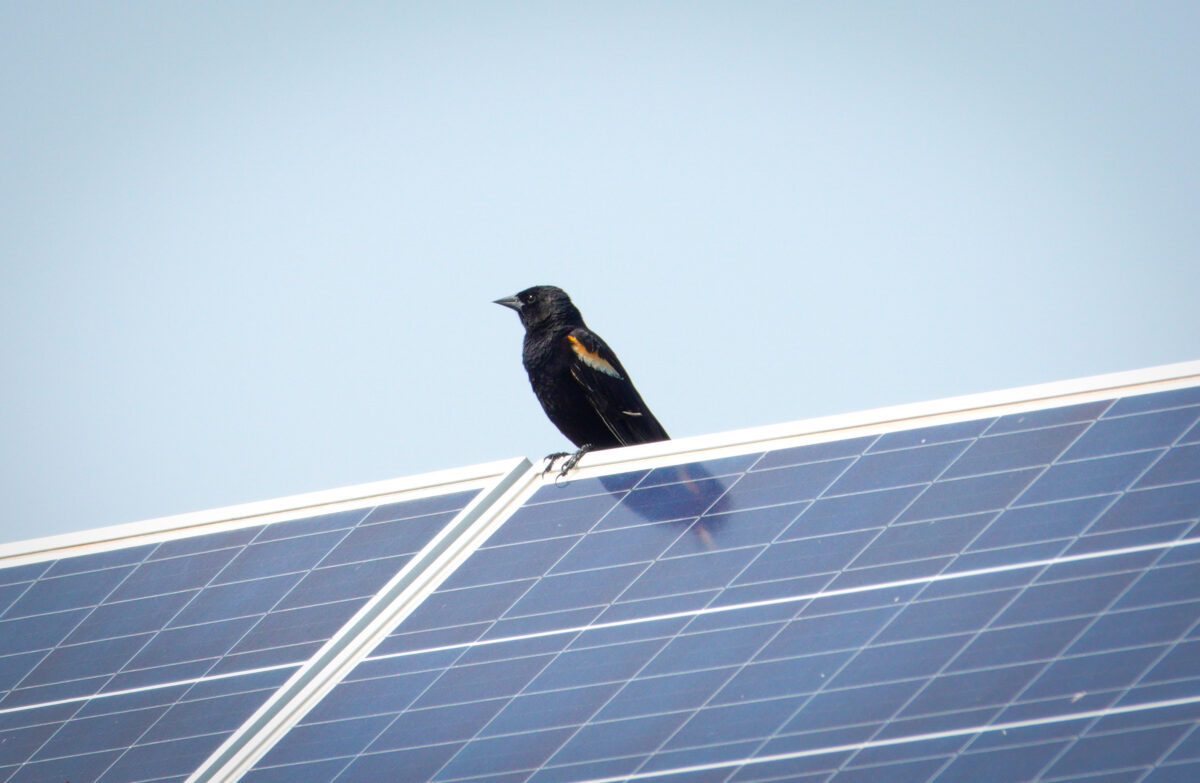
The research paper “The development of ecovoltaic solar energy can promote grassland bird communities”, available in the British Ecological Society, found that meadow bird species richness was almost twice greater in the ecovoltaic sites than in the agricultural reference fields during most of the monitoring season.
Most meadow bird species also showed higher occupancy at the ecovoltaic sites. The research team found more than 230 bird nests at the basking sites during the study period, most of which belonged to species including the American robin, barn swallow and mourning dove.
In the research paper, the team writes that birds may be attracted to ecovoltaic systems as a refuge or habitat for foraging and nesting, with some species may also want to nest on or within the PV infrastructure, to protect nests from predators and extreme weather.
The researchers add that the paper is the first to empirically report on the responses of bird communities at ecovoltaic sites in the US and suggest that future work should examine whether increased bird occupancy at solar ecovoltaic sites results in improved population fitness and viability by studying metrics such as nesting success and collision mortality risk.
Image: L. Walston, Argonne National Laboratory
The research paper Bat activity at solar ecovoltaic developments in the Midwestern United Statesavailable in the research journal Global ecology and conservation, highlights that bat activity was greater at solar ecovoltaic sites than at external monitoring fields during the first half of the summer monitoring season.
Species such as the Big Brown Bat and the Haory Bat were noticeably more active at the ecovoltaic sites. During the entire monitoring season, bats never showed a higher activity level on the reference agricultural areas.
These findings lead the researchers to conclude that early-season ecovoltaic sites can provide habitat for bats at a time of year when resources in the surrounding landscape may be limited.
The research paper’s conclusion adds that it remains difficult to distinguish whether bat activity was driven by PV infrastructure, on-site habitat establishment, or a combination of both. It adds that further research into the types of bat calls recorded at PV sites, and its relationship with insect prey abundance, are needed to understand the underlying drivers of species-specific responses to solar developments.
The research team told pv magazine that since the vast majority of PV projects are located on previously disturbed lands previously used for agricultural production, the intentional establishment of habitat on these PV projects can have meaningful biodiversity benefits.
“It is encouraging that a growing number of PV sites in the Midwest are implementing ecovoltaic principles, as evidenced by the InSPIRE agricultural mapshowing the promise that these innovative PV designs can provide a nature-based solution to reconcile energy development with biodiversity conservation,” the team added.
“Our results show promisingly that birds and bats can benefit from ecovoltaic designs on previously disturbed areas. But we still need to ensure that these sites are managed in a way that ensures long-term biodiversity benefits. That is why continued monitoring and adaptive management are so important.”
This content is copyrighted and may not be reused. If you would like to collaborate with us and reuse some of our content, please contact: editors@pv-magazine.com.
Popular content