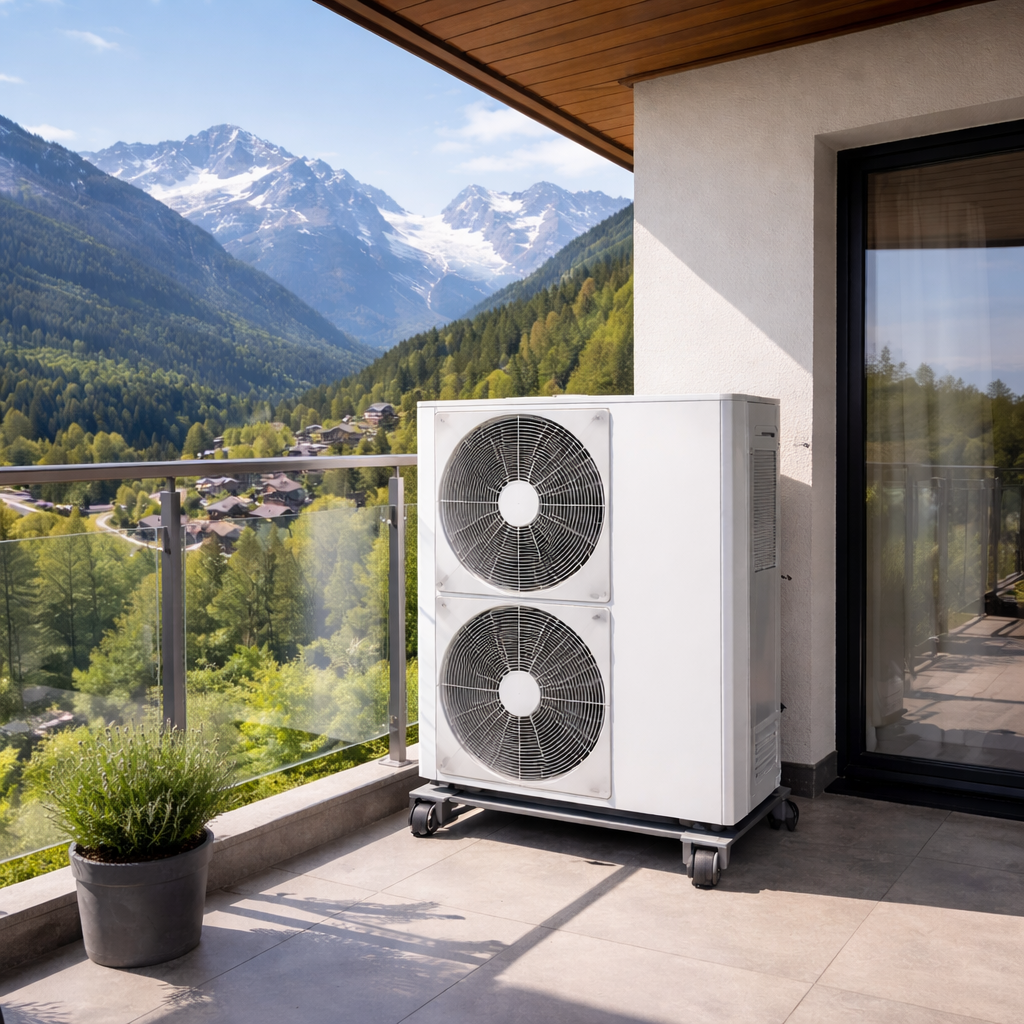
Researchers in Italy analyzed the performance of air-to-water heat pumps in Alpine regions, focusing on how start-up and defrost cycles affect efficiency under current and future climate conditions. Their simulations show that while warmer temperatures reduce defrost losses somewhat and improve efficiency modestly, start-up losses remain significant and continue to limit overall performance gains.
Scientists from Italy’s University of Trento have investigated the impact of start-up and defrost cycles on a PV-coupled air-to-water heat pump (AWHP) in the Alps, climate change hotspots characterized by rapid warming and complex topography.
“The novelty of this study lies in the explicit integration of experimentally derived and validated correlations of start-up and thaw degradation into a dynamic TRNSYS framework, where the performance of AWHP can be assessed under current and future climate conditions at any location worldwide,” said corresponding author Fabian Eze. pv magazine.
Eze further explained that the alpine climate is characterized by complex topography, causing AWHPs to experience unique operational dynamics such as frequent on-off cycles and defrost cycles.
“These transient effects often lead to performance degradation, but in conventional simulations they are often overlooked. Consequently, AWHP performance is consistently overestimated, resulting in unrealistic dynamic performance ratings,” he said.
In their simulation study, the AWHP was coupled with a 4 kW PV system, a grid connection, a 3 kWh battery energy storage system (BESS), a 277 liter combined thermal storage tank for heating/cooling and a 156 liter domestic hot water tank. The AWHP used R32 as a coolant and was inverter controlled. It had a rated cooling and heating power of 8.73 kW and 9 kW respectively, corresponding to an electrical input power of 2.11 kW and 1.89 kW for cooling and heating operation.
The research team simulated the operation of the AWHP under the expected conditions for 2030 and 2050.
Image: University of Trento, Energy, CC BY 4.0
The systems have been simulated for installation in a single-family home with a total heated floor area of 140 m², divided into four thermal zones. The houses were believed to be located in five municipalities in the Italian province of Trentino: Arco, Trento, Storo, Cavedine and Cles. These municipalities cover different altitudes of 83 m, 185 m, 384 m, 549 m and 652 m respectively.
The base climate year was 2016, with future weather data generated using the Test Reference Years model. Between 2016 and 2030, the expected increase in average air temperature ranges from 0.48 C in Arco to 0.6 C in Cles. By 2050, warming will become even more pronounced, with an increase of 1.24 °C in Arco and 1.50 °C in Cles.
“One of the most surprising findings is that the start-up and defrost effects are not small corrections,” says Eze. “Start-up alone reduces the seasonal coefficient of performance (SCOP) by approximately 4% to 6%, while the combined effects of start-up and defrost reduce SCOP by 9% to 11% and increase annual primary energy consumption by up to 12%.”
The researchers explained that although future climate change reduces defrost frequency, start-up losses remain significant as the part-load cycle continues. “For example, SCOP is expected to increase by approximately 6% by 2050, leading to a reduction in annual primary energy consumption of up to 10%. These results will help inform the future technical design of AWHP systems and policy development for the decarbonization of these regions,” Eze said.
Overall, in future climate scenarios, increasing temperatures are expected to reduce defrost frequency, somewhat improving seasonal efficiency. However, this benefit is only partial, as start-up losses due to part-load cycles persist and continue to affect overall system performance. As a result, although climate change may modestly improve heat pump efficiency in colder regions such as the Alps, the improvement is limited and does not detract from the importance of accurate dynamic modelling.
The findings highlight the need for more detailed simulation approaches that capture real operating conditions, as well as careful system design and policy planning to support reliable and efficient electrified heating solutions in a carbon-free energy system.
The research work was presented in “Performance assessment of air-to-water heat pumps in mountain areas under current and future climate: impact of start-up and defrost cycles”, published in Energy. “Our future work will focus on validating the framework with site-specific monitoring data and expanding the analysis to other building types, such as multifamily and commercial buildings,” Eze concluded.
This content is copyrighted and may not be reused. If you would like to collaborate with us and reuse some of our content, please contact: editors@pv-magazine.com.
Popular content