Researchers from the German institute found that some commonly used PV cleaners can damage anti-reflective glass coatings, significantly reducing the efficiency of solar panels. Their tests showed that while some cleaning products are safe, others cause visible and permanent degradation of the coating. This highlights the need for careful selection of cleaning products to avoid long-term performance loss.
Researchers from Germany’s Fraunhofer Center for Silicon Photovoltaics (CSP) have evaluated the impact of various PV cleaning products on module glass surfaces and found that certain commercially available cleaners for photovoltaic modules can significantly damage anti-reflective glass coatings and reduce energy yield.
The researchers tested five commercially available cleaning agents in addition to pure deionized (DI) water, which served as a reference. The goal was to determine whether chemical cleaners used during PV maintenance can degrade the anti-reflective coating (ARC) commonly applied to the glass of solar panels.
“The tested cleaning agents are market-leading products, which are freely available on the European market. Only one of the cleaning agents is a special purpose cleaner, while all the others are promoted as universal PV cleaners,” Fraunhofer told CSP researcher Marko Turek. pv magazinewithout giving further details.
Experimental setup
The scientists exposed the panel glass to the cleaning agent at 55 C for 24 hours. “This corresponds to a total wetting time over the lifetime of PV modules, assuming frequent cleaning, while a module temperature of 55 C is also not unusual in direct sunlight,” Turek explains. “Yet our goal was not to replicate one of the many possible application scenarios, but to compare the cleaners under reproducible and controlled conditions.”
After exposure, the team quantified the optical performance of the glass through optical measurements, specifically regarding optical transmission. “We found that some products had a greater impact than others, and that there was quite a wide spread among the five cleaners we surveyed,” Turek said. “The change in optical performance would translate directly into a power loss for PV modules. If the ARC is degraded and anti-reflective functionality is lost, the module will produce less power.”
“We have not conducted any chemical analysis of the cleaners themselves,” Turek continued. “Our main goal was not some kind of reverse engineering, but rather to provide an objective screening test. And for us, it was about raising awareness that PV system owners really need to check, before using a cleaning solution, that the cleaning solution will not damage their modules.”
Relegation
Three of the five cleaners tested caused measurable degradation of the anti-reflective coating, leading to optical losses that translated into reduced PV performance. In the most severe cases, the researchers calculated performance loss of up to 5.6%. This number refers to the power loss of the solar panel compared to a panel with undamaged glass coating.
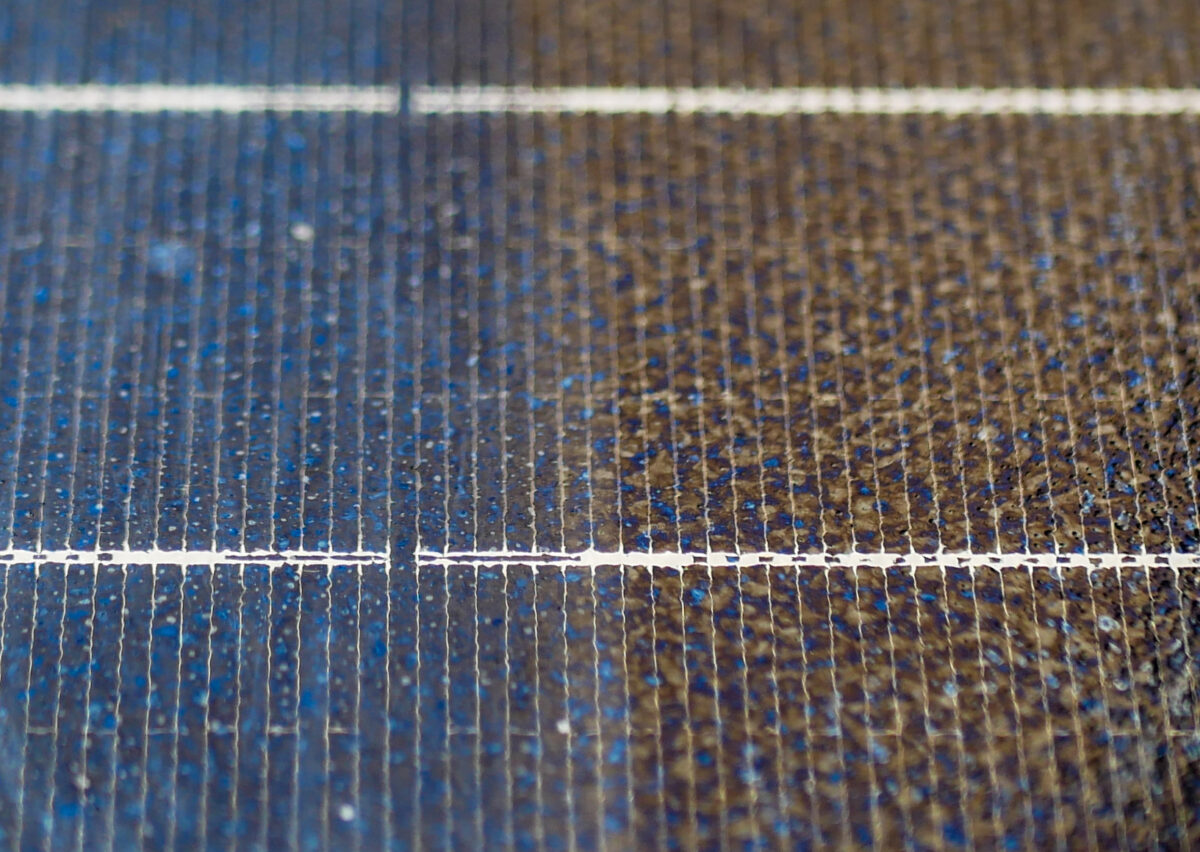
In contrast, two of the cleaners tested did not produce significant degradation, comparable to the DI water reference. Microscopy images confirmed the underlying cause: ARC-coated glass exposed to the damaging cleaning agents showed visible surface degradation, while samples treated with the non-damaging agents retained largely intact coatings.
Image: Fraunhofer CSP
“We saw that the anti-reflective coating was really damaged,” Turek explains. “With the three cleaners that had a strong impact, there are parts where it is still present and there are other parts where it has been removed. With the other two cleaners it still looks very uniform. The change is visible to the human eye. The color rendering is a bit non-uniform, so you see a rainbow color there.”
“We have even noticed that some aggressive PV cleaning products are marketed as certified or tested as material compatible. This is because cleaning products are assessed under very different conditions and in some cases standards are used that are inappropriate or incorrectly applied. All this has prompted us to conduct more in-depth research into the effects of cleaning agents. We can also support industry partners – both module component manufacturers and cleaning agents – with corresponding analyses. In particular, we can help investors and park operators select suitable cleaning agents,” Turek said.
Outlook
The researchers explained that the damage to ARC is permanent and likely caused by a chemical reaction, as no mechanical stress was detected during the experiments. “There are currently companies that can repair the module or retrofit it with another ARC,” the scientist said. “But as I know, it’s not like it happens on a regular basis. So it’s not like every PV park gets a retrofit every five years. It’s more of an idea or an active development process where it could work from a technological point of view. I’m not sure if it works from a commercial point of view.”
He also explained that cleaning agents are used in solar farms to reduce the mechanical stress caused by robots or mechanical brushes. “PV plant operators who want to reduce scratches and abrasive effects should use chemical cleaners, but that only makes sense if the damage you avoid when brushing is not caused by the cleaner, because then you gain nothing,” he said.
In the next step, the Fraunhofer CSP researchers want to investigate the relationship between actual cleaning performance and possible damage to the ARC. This research will be based on their expertise in analyzing the microstructure of materials. The purpose of an in-depth study of the interaction between chemical and mechanical effects is to derive recommendations for the industry.
This content is copyrighted and may not be reused. If you would like to collaborate with us and reuse some of our content, please contact: editors@pv-magazine.com.
Popular content