

A research paper from scientists at Swansea University describes their tool for analyzing the thermodynamic limits of organic semiconductor-based solar photovoltaics (OPVs). One of the findings was that semi-transparent solar energy, applied in greenhouses, can deliver comparable performance to conventional crystalline silicon PV.
Scientists from Swansea University in the United Kingdom have developed a tool to help identify optimal photovoltaic materials for agricultural voltaics.
The research paper “On the performance limits of agricultural voltaics – from thermodynamic to geo-meteorological considerations,” published in the magazine Solar RRL, investigates the thermodynamic limits of organic semiconductor-based solar photovoltaics (OPVs) and their potential performance as agricultural voltaics.
The team developed a freeware tool that predicts the light transmission, absorption and energy generation of various solar materials using geographical, physical and electrical measurements. They say it can be applied virtually anywhere in the world and that, to their knowledge, it is the first accurate device-level model to predict the thermodynamic performance limits of various semiconductors for semi-transparent agricultural voltaics.
“This technology, which allows us to compare many types of PV materials, could help us determine how we balance food production and renewable energy generation,” said Austin Kay, lead author of the study.
The paper says the instrument will be particularly valuable for molecular semiconductors such as organics and perovskites, “where tunable bandgaps and electro-optics can be manipulated and developed.”
A university press release explains that some PV materials have a wide band gap, meaning the material absorbs higher energy light with a shorter wavelength, usually blue light, while materials with a narrower band gap absorb lower energy and a longer wavelength absorb, usually red. light. Such knowledge can help select the right materials for semi-transparent agrivoltaic energy, because crops mainly absorb red and blue light for photosynthesis, thereby reflecting green light.
In the paper’s conclusion, the researchers explain that the active layers of semi-transparent OPVs should be approximately 100 nm thick for optimal agrivoltaic performance, with the exact thickness required depending on the optical and transport properties of a particular device.
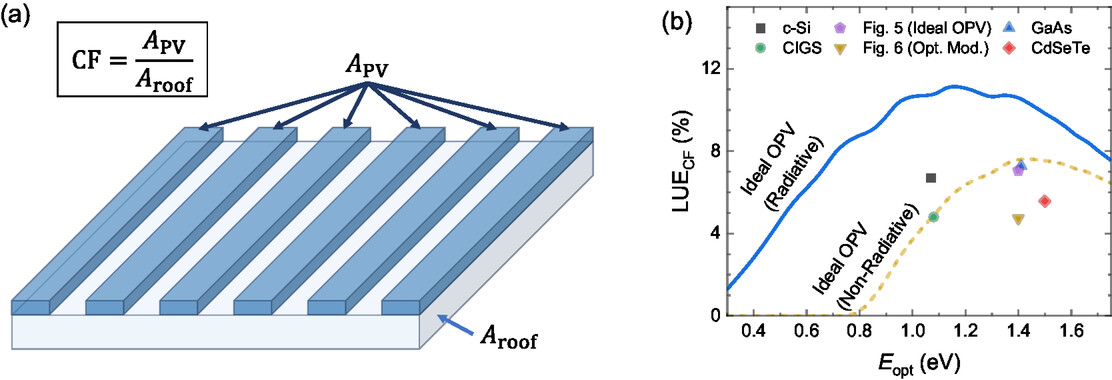
During their research, the team also defined a coverage factor (CF) for the use of PV cells on a protected cultivation structure, such as a greenhouse. They found that the light use efficiency (LUE), which quantifies the amount of incident light converted into electrical energy or made available to crops by PVs, of semi-transparent agrivoltaics based on OPVs is comparable to that of opaque solar cells based on inorganic semiconductors such as crystalline silicon or gallium arsenide.
“Overall, we found that state-of-the-art inorganic PVs generate more power per square meter than semi-transparent OPVs, but that the CF-weighted LUEs of OPVs can compete with established inorganic systems,” the paper concludes.
The researchers add that other considerations may influence agrivoltaic energy choices, including the stability of the device, the robustness of the protected growing environment, the local climate, the time of year and the crop’s wavelength sensitivity. “It is never just a matter of maximizing transmission and energy generation,” the paper says.
Earlier this year, a project led by Swansea University began exploring the potential of setting up production centers for low-cost PV modules in Africa, Asia and the Indo-Pacific.
This content is copyrighted and may not be reused. If you would like to collaborate with us and reuse some of our content, please contact: editors@pv-magazine.com.
