

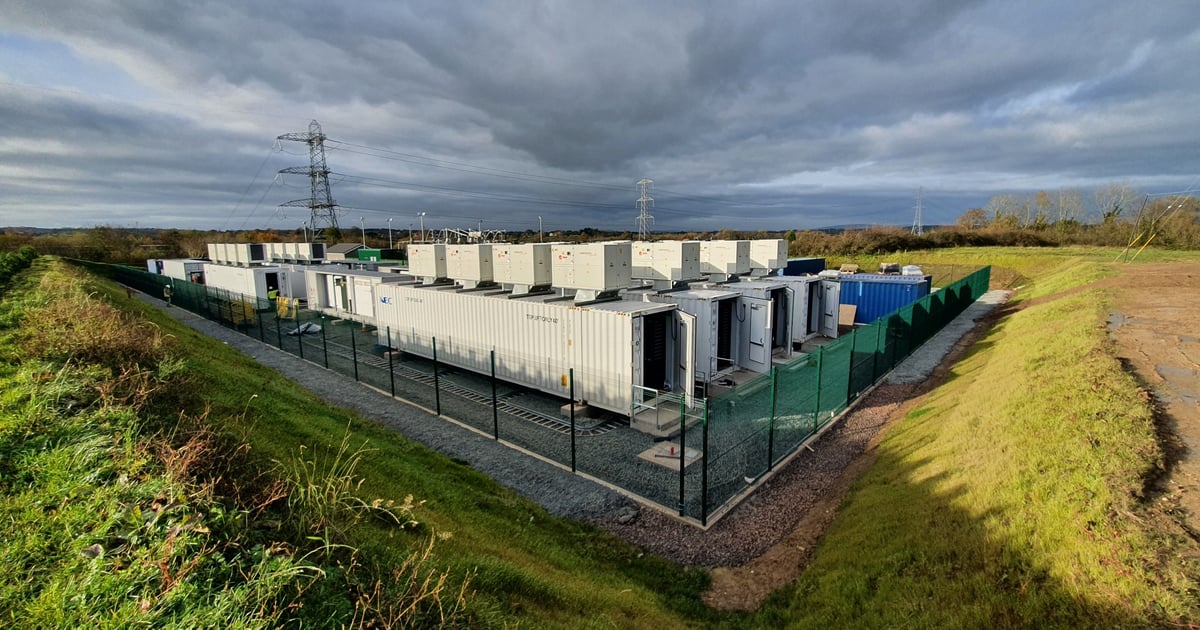
The Gore Street Energy Storage Fund (GSF) has posted a big drop in net asset value (NAV) for the financial year ending March 31, 2026, in a year it described as difficult but consistent with the cyclical nature of the sector.
Net asset value (NAV) fell 14.8%, or 13p, to 74.9p per share in the fourth quarter of the company’s financial year, taking the total decline for the twelve months to March 31 to just over 27%.
The fund, a subsidiary of Gore Street Capital, acquires, builds and operates utility-scale battery energy storage systems (BESS). It owns 28 assets across California, Ireland, Great Britain, Germany and Texas, with a combined capacity of 1.16 GW.
Project revenues fell below previous expectations and averaged £7.32/MWh, compared to £9.56/MWh in the previous financial year. Despite additions to GSF’s portfolio, adjusted fund profits fell 39.2% year-on-year.
GSF noted that this decline is the result of challenging market conditions in Britain and Texas. UK revenues averaged just £5.60/MWh, and the fund said this demonstrates the benefit of diversifying beyond a UK-only portfolio.
The decline occurred before the current administration’s strategy was implemented
The fund’s chairman, Angus Gordon Lennox, was keen to emphasize that the current board has only been in place since February 1 this year, “so it’s literally two months into the new board we’re talking about.”
After “persistent underperformance” in 2025, a prominent long-term shareholder of GSF, RM Funds, requested a review of the company’s board of directors and urged the fund to sell non-core assets, return capital to shareholders and pursue a merger or sale.
Immediately new board compositionincluding Lennox as chairman, GSF announced a new strategy in Marchand says the board “recognizes that the change in the macro environment necessitates this evolution in its buy-and-hold strategy.”
As Lennox indicated at the start of the earnings call, the effect of this in the coming financial year remains to be seen.
He noted that “battery energy storage remains critically important” despite what has “clearly been a challenging period for the company’s valuation.”
Lennox said that in the months since late March, “the new board has taken significant action.” In March it announced a new capital recycling strategy, including its sale 22MW/28MWh Cremzow BESS in Germany which started in October 2025. An update on this was given in GSF’s earnings call, which stated that the sale is in advanced stages of negotiations.
A partial or full sale process has begun for the company’s pre-construction assets in the Republic of Ireland, and for the pre-construction 200MW Middleton BESS in Great Britain. GSF said further updates on this will follow later in the summer.
It also said that while construction work on the 57MW/57MWh Enderby BESS has been completed, the company has not been able to access revenue streams due to grid connection restrictions. It should be fully operational in the coming weeks.
Maturity extensions are being implemented to improve revenue performance
It’s worth noting that the majority of GSF’s GB assets are one-hour projects, which is partly why revenues per megawatt hour have been low. The company is expanding two projects, Stony and Ferrymuir, which it says are ahead of schedule with 130MWh of additional capacity to be completed consecutively in October, November and December.
During a question-and-answer session at the end of the earnings call, the board was asked about term extensions. GSF management clarified that the UK portfolio will transition from 1-hour systems to 2-hour systems, Texas already has 2-hour assets and California has 4-hour systems. As the policy environment in Ireland develops, projects there may be able to expand.
Broader challenges facing BESS funds
A similar UK-listed fund targeting BESS is Gresham House Energy Storage (GRID), which has a portfolio of 2-hour assets but is also feeling the pressure. His approach was reversed enter into an investment partnership with an entity controlled by Sumitomo Corporation to reduce the risk of the company by reducing the required equity.
The BESS funds have struggled since values plummeted over the course of 2023 and early 2024 as income fell in Britain, leading to another fund, the Harmony Energy Income Trust (HEIT), sold and taken private.
The sale of HEIT’s UK portfolio raised questions about the viability of listed funds for BESS assets. At that time, an anonymous BESS developer source told our sister site Energy storage.news that HEIT’s problems, which led to its sale, raised the question of whether these funds are the best way to raise money for BESS projects in the market.
In February, the Association of Investment Companies said widespread NAV discounts “reveal poor investor sentiment toward renewables” but also “make it impossible for trusts to raise money, grow and upgrade their portfolios.”
Other renewable energy-focused funds are feeling the pressure. NextEnergy Solar Fund (NESF) started a ‘reset’ in March after a year of low share prices and low net asset value (NAV). At that stage, energy storage was seen as a source of revenue, but yesterday it emerged that this is the case looking for expressions of interest from potential buyersafter concluding that a sale would be “in the best interests of the shareholders”.
