

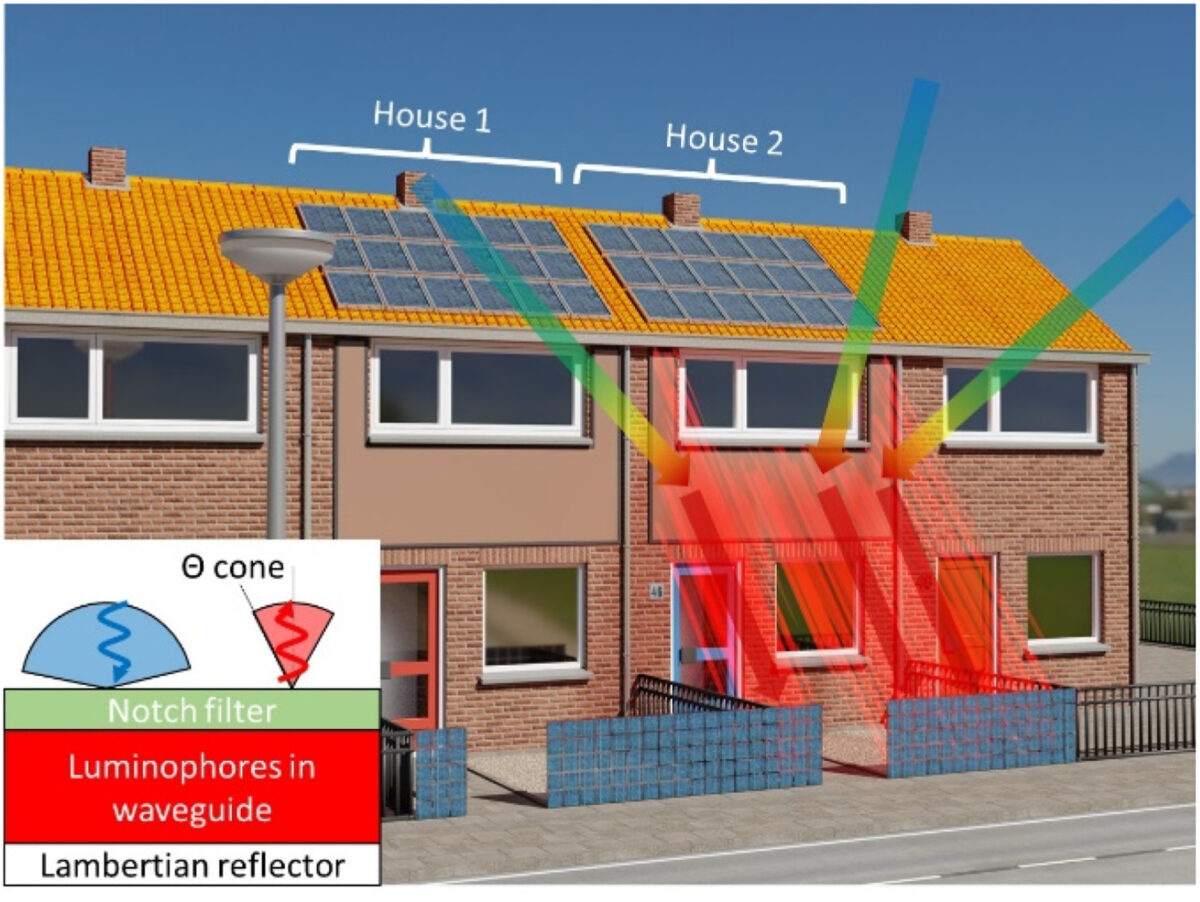
New research from the Netherlands shows that the use of luminescent free-space solar concentrators can be used to significantly improve the performance of dual-sided solar modules in vertical residential installations. The scientists are confident that a variety of bifacial PV systems can be designed and deployed with this technology in the future.
Researchers from the University of Twente in the Netherlands have investigated how free-space luminescent solar concentrators (FSLSCs) can be used to improve the performance of bifacial PV modules in vertical PV installations and have found that electricity production could increase by up to 60% over the next few years. be increased. winter.
LSCs are commonly used as photonic devices in the production of fine chemicals in photomicroreactors, in dynamic ‘smart’ windows to control the light entering spaces, and for the distribution of color-matched light to enhance plant growth in greenhouses. They can also be used to improve the efficiency of solar panels. The LSCs consist of luminescent materials also called luminophores groups of molecules that emit light when illuminated.
The materials can be applied to the surface of a polymer or glass plate, or used as a dopant for the polymer or glass plate and act as a light guide. She can capture direct and indirect sunlight at one wavelength and re-emit it at a longer wavelength. When applied to PV, luminophores can capture high-energy photons that the photovoltaic panels cannot absorb and re-emit them as photons.
FSLSCs are described by the Dutch research team as systems that can absorb broad-spectrum sunlight and re-emit it as red-shifted photons within a controlled emission cone. This light is then redirected to the nearby solar panels.
The experimental setup consisted of a rooftop PV system and several double-sided panels placed vertically on a fence in the garden of a single-family home. The FSLSCs are deployed on the south facade of the house and appear as a brownish surface with no texture. They are reportedly able to absorb the full visible solar radiation from all angles and emit red-shifted photons in a narrow emission cone facing the back of the dual-sided solar modules.
Image: University of Twente, Solar Energy Materials and Solar Cells, Common License CC BY 4.0
The scientists conducted their analysis by measuring the performance of the FSLSCs with those of mirror mirrors and diffuse reflectors for light reflection. “Our findings indicate that FSLSCs with a 40° emission cone can significantly increase energy yield, especially during winter months, and outperform specular mirrors and diffuse reflectors by providing better yield without the problem of uneven illumination,” they explained.
They also found that FSLSCs can increase energy production in winter by up to 60%. “Overall, FSLSCs improve annual energy yield by 12% compared to conventional monofacial systems, providing a more balanced distribution of solar energy generation throughout the year,” she added. “We believe that a variety of bifacial PV systems with diffuse reflectors and FSLSCs can be designed to significantly improve the performance of solar energy systems.”
The new concept was introduced in the study “Optimizing bifacial PV performance: the impact of reflectors and luminescent free-space solar concentrators on winter yield”, published in Solar energy materials and solar cells.
Looking ahead, the academics said they will investigate reflection and shadowing from surrounding structures and how heat can affect the optical properties of FSLSCs.
This content is copyrighted and may not be reused. If you would like to collaborate with us and reuse some of our content, please contact: editors@pv-magazine.com.
Popular content

