

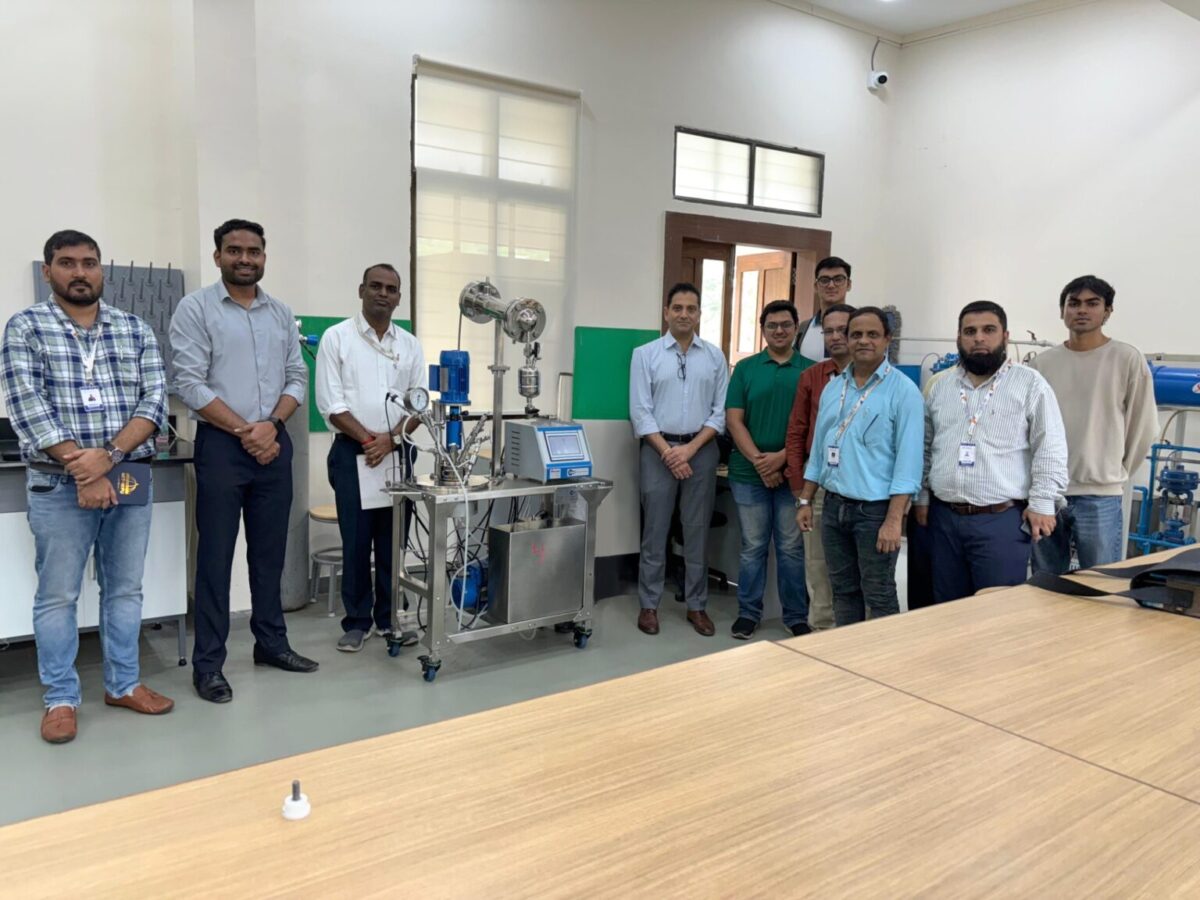
Researchers at MIT World Peace University (MIT-WPU) in India have developed a liquid organic hydrogen carrier system (LOHC) that can transport hydrogen in a stable liquid form. The system is non-flammable, non-explosive and can be used at normal temperatures and pressures.
Researchers from India’s MIT World Peace University (MIT-WPU) have developed a liquid organic hydrogen carrier system (LOHC) that can transport hydrogen in a stable liquid form that is non-flammable, non-explosive and controllable at normal temperatures and pressures.
The proposed technology addresses one of the biggest obstacles slowing the widespread adoption of hydrogen in India.
“The innovation started when Ohm Cleantech Pvt. Ltd. (OCPL) approached MIT-WPU to solve a problem that had remained unsolved at large institutions,” said the study’s lead author, Rajib Kumar Sinharay. “There was no documented methodology available worldwide, so the research team had to conceptualize and build the entire process from scratch.”
Details of the patented method remain confidential while OCPL advances international patent applications.
“The progress made marks a major step forward for safe, innovative, cost-effective and scalable hydrogen transportation,” said Siddharth Mayur, Founder of OCPL. “It strengthens our efforts as we move forward with international patent applications. OCPL is pleased to advance this research toward a commercial product that aligns with the National Green Hydrogen Mission and the vision of Atma Nirbhar Bharat (self-reliant India) as envisioned by Honorable Prime Minister Narendra Modi.”
Despite being one of the cleanest fuel options available, hydrogen is difficult to integrate into energy systems due to its highly explosive nature and the extreme conditions required for transportation. Currently, hydrogen is either compressed in high-pressure cylinders, often hundreds of times higher than atmospheric pressure, or liquefied at temperatures below 253 C. Both methods require complex infrastructure, extensive safety measures and significant investments, making transportation one of the most expensive components of the hydrogen supply chain.
MIT-WPU’s LOHC innovation addresses these challenges through a two-stage chemical process.
During the hydrogenation phase, hydrogen is chemically bonded into a specially designed organic liquid, converting the gas into a safer liquid form for storage and transportation. In the dehydrogenation phase, hydrogen is released at the point of use, while the carrier fluid remains reusable. Because the hydrogen-rich liquid can be processed like conventional fuels, it can be transported using existing tankers, storage facilities and potentially off-the-shelf pipeline networks, significantly reducing costs and transportation risks.
Laboratory results place India at the forefront of LOHC development. The MIT-WPU team achieved full hydrogen storage in just two hours, compared to about 18 hours reported in similar global studies. The process operated at a lower temperature of 130 C, compared to the typical 170 C, and at a relatively low pressure of 56 bar. Nearly 11,000 liters of hydrogen were stored in just 15.6 liters of carrier fluid. In dehydrogenation trials, the team successfully recovered 86% of the stored hydrogen, with ongoing research aimed at further improving efficiency.
“The ability to transport hydrogen like any other industrial fluid removes long-standing safety and regulatory barriers,” said Datta Dandge, research advisor. “This breakthrough has the potential to accelerate the national hydrogen mission and reshape clean energy logistics for transportation and heavy industry.”
The research was conducted at MIT-WPU’s advanced hydrogen laboratory, which is equipped with an autoclave system that can operate at temperatures up to 350 C and a pressure of 200 bar. The team is now focused on refining the process and scaling from laboratory success to industrial implementation.
This content is copyrighted and may not be reused. If you would like to collaborate with us and reuse some of our content, please contact: editors@pv-magazine.com.
