

Researchers in the Netherlands have developed a model to identify acceptable top cell degradation rates in perovskite-silicon tandem modules. Simulations showed that increasing the efficiency of the tandem modules from 28.0% to 32.9% could increase the acceptable degradation rate by approximately 50%.
To identify the acceptable degradation rate of perovskite subcells in monolithic two-terminal tandem modules, researchers from Delft University of Technology (TU Delft) in the Netherlands have developed a dual model. It predicts lifetime energy yield and degradation rates under different environmental conditions.
“The novelty of this study is that we combine a physical approach with a scenario-based approach to determine the acceptable degradation rate,” says first author of the study, Youri Blom. pv magazinenoting that the fully simulation-based approach relied on metrics from various literature sources.
Similar studies in the past have relied on a physical approach for conventional crystalline silicon modules or a fully scenario-based approach for perovskite-based modules.
“To see how the acceptable degradation rate of the perovskite cell depends on climate, we combine these two approaches to obtain i) climate-dependent information for the silicon bottom cell, and ii) a scenario approach for the perovskite top cell,” Blom explains, noting that modeling is required for perovskite devices because there is insufficient outside data available to calibrate and design physical equations.
After identifying the acceptable degradation rates for the perovskite cell, ensuring that the perovskite silicon module continues to outperform the crystalline silicon module, several degradation scenarios were analyzed. The degradation mechanisms in the model were discoloration, moisture-induced degradation (MID), thermal cycling-induced degradation (TC), and light-induced degradation (LID), as these mechanisms are the most severe or occur most frequently, according to the article.
Limitations of the previously validated PVMD Toolbox used to build the model did not allow for hot spot and potentially induced degradation (PID) consideration, the researchers noted.
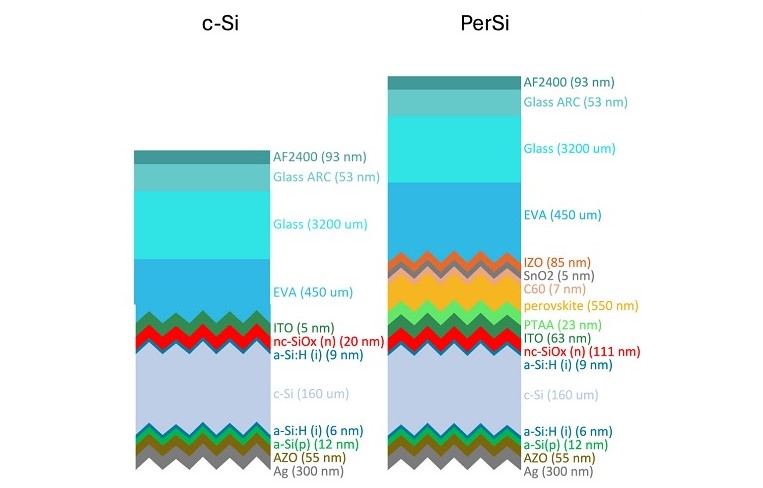
The environmental stressor-dependent degradation was investigated at four locations, each with a different climate: Delft, Lagos, Lisbon and Shanghai. The modeled cell was a 144 half-cut perovskite-silicon tandem device with a G12 wafer size connected in a butterfly topology with three bypass diodes. The cell stack was based on a 32.5% efficient two-terminal design from the literature.
The results showed that in Delft, “where the module lifetime is high, the perovskite top cell should be very stable because a degradation rate of only 1.9% can be tolerated,” but that in Lagos, where the “module lifetime is short, a higher perovskite degradation rate of 7.6% can be tolerated,” according to the article.
The team noted that the type of degradation, current or voltage loss, in the subcell affects the overall power loss differently. For example, a 10% current loss in the perovskite subcell results in a power loss of 8.7%, while a 10% voltage loss results in a 6.2% power loss. “This shows that the degradation in both the perovskite and silicon subcells is relevant, and that a single degradation rate is not sufficient,” the report said.
Further results showed that increasing the module efficiency from 28.0% to 32.9% increased the acceptable degradation rate by approximately 50%.
As part of the research, the group developed a simplified model to reduce computationally intensive simulations, an Arrhenius-based model. Module efficiency and ambient temperature are used to “effectively and accurately” predict outcomes for chosen locations with a root mean square error of 0.34% per year.
Furthermore, an efficient empirical model was created to calculate the degradation rate for other locations and cell efficiencies. “It can be used by other researchers or manufacturers,” says Blom
The model can also be applied to environmental impact studies of perovskite-silicon modules. “By using life cycle assessment (LCA) results from the literature, the comparison between crystalline silicon and perovskite/silicon can also be extended to the ecological footprint,” says Blom.
Currently, the research group is working on topics related to the circularity of PV modules, such as analyzing the sustainability of PV panels, including PV-related critical demand for raw materials, designing PV modules for circularity, as shown in his recently reported work on encapsulation of liquid PV modules and investigating module aging, which this study belongs to, Blom said.
The work is described in detail in “Combining physical and scenario-based modeling to identify acceptable perovskite degradation rates in monolithic two-terminal perovskite/silicon tandem modules”, published in Solar energy materials and solar cells.
This content is copyrighted and may not be reused. If you would like to collaborate with us and reuse some of our content, please contact: editors@pv-magazine.com.
