

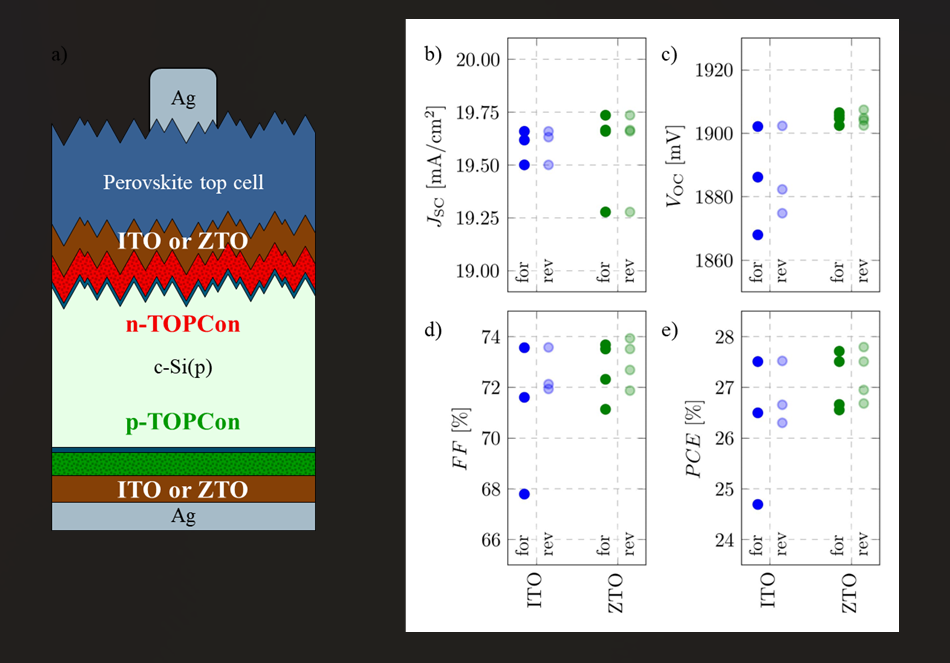
Researchers led by Fraunhofer ISE have demonstrated zinc-doped tin oxide (ZTO) as an indium-free alternative to indium tin oxide (ITO) for recombination layers in fully textured perovskite-silicon tandem solar cells. ZTO delivers comparable device efficiencies of 27-28% under current conditions, providing a scalable, indium-free path to high-performance tandem solar photovoltaics without efficiency losses.
An international research team led by Germany’s Fraunhofer Institute for Solar Energy Systems (Fraunhofer ISE) has fabricated a perovskite-silicon tandem solar cell based on a transparent conducting oxide (TCO) made of zinc-doped tin oxide (ZTO) in an attempt to rival counterparts made of indium tin oxide (ITO).
“The novelty of this work lies in demonstrating ZTO, an indium-free TCO, as a viable recombination layer for fully textured perovskite-silicon tandem solar cells on industrially relevant TOPCon bottom cells,” said the corresponding author. Sadaf Ghasemi told it pv magazine. “Unlike
Conventional ITO, which relies on unsustainable and scarce indium unsuitable for mass production, ZTO matches ITO performance using the same scalable DC sputtering process of rotating targets in an inline tool.
“We systematically studied the structural, chemical and optoelectric properties of ZTO, aluminum doped zinc oxide (AZO) and ITO,
and investigated their influence on the formation of the hole transport layer (HTL). We found ZTO’s superior compatibility with hybrid processed perovskite top cells on TOPCon-based perovskite-silicon tandem solar cells, with no efficiency loss compared to ITO.”
In the study “Indium-free recombination compounds on tunnel oxide passivating contacts for fully textured perovskite/silicon tandem solar cells”, published in RRL solar energyGhasemi and her colleagues explained that their analysis was performed on ohmic n-TOPCon substrates consisting of textured n-doped silicon wafers with TOPCon layers on both sides, which are hydrogenated after crystallization.
AZO, ITO, and ZTO transparent conductive oxides were deposited on both sides by DC sputtering under previously optimized conditions, followed by curing to limit sputtering-induced damage. All layers were sputtered at 30 nm and optimized for minimal damage while ensuring good electrical contact, evaluating properties before and after an annealing step at 300 C.
Image: Fraunhofer ISE
The impact of processing was evaluated using spatially averaged implicit open circuit voltage (iVOC) from photoluminescence (PL) measurements before sputtering, after deposition, and after curing. AZO caused the strongest initial passivation loss, while ITO and ZTO caused only moderate degradation; however, all materials recovered to high no-load values after annealing. Contact resistance measurements showed that AZO exhibits the lowest values and remains stable after curing, while ITO and ZTO exhibit higher resistance that moderately increases upon annealing, while still remaining suitable for tandem device integration.
Hall effect measurements further showed that ITO is the most conductive TCO due to its high carrier mobility. ZTO improves upon annealing as a result of increased carrier concentration, while AZO suffers from pronounced mobility loss and a corresponding increase in sheet resistance. Overall, these results demonstrated that sputtering parameters and annealing strongly influence the structural and electrical properties of the TCOs, while subsequent HTL processing largely homogenizes the interfacial surface behavior for all materials.
Substrate crystallinity and surface-related parameters such as contact angle and work function were found to be poor predictors of full device performance, as AZO deviates significantly despite apparently favorable interfacial characteristics.
The three tandem device configurations based on ITO, AZO and ZTO showed clear photovoltaic performance. AZO-based devices achieve high open-circuit voltage but poor efficiency due to low short-circuit current density and fill factor, likely caused by contact transport limitations or interfacial instability. In contrast, ITO and ZTO-based devices exhibit consistently high performance with comparable efficiency, indicating minimal selectivity losses and efficient hole extraction.
Overall, both ITO and ZTO are viable recombination layers, with ZTO identified as particularly promising for tandem integration due to its comparable electronic and optical performance. “Under current conditions, ITO and ZTO-based devices achieve comparable efficiencies of 27-28%,” Ghasemi concluded.
The research group consisted of academics from the University of Freiburg in Germany and the University of Twente in the Netherlands.
This content is copyrighted and may not be reused. If you would like to collaborate with us and reuse some of our content, please contact: editors@pv-magazine.com.
Popular content

