

British scientists have proposed a way to combine photovoltaic and thermal energy with Stirling engines and battery storage in residential buildings. Despite the high initial costs, they said the cost-effective hybrid cogeneration system could significantly reduce CO2 emissions.
Researchers from the University of Durham in the UK have developed a hybrid cogeneration system that combines photovoltaic thermal (PVT) collectors with a Stirling engine (SE) and battery storage. The system is designed to meet the demand for electricity and domestic hot water (DHW).
“The advantages of such a hybrid system are that it can immediately significantly reduce primary energy consumption and household energy bills,” said researcher Shunmin Zhou. pv magazine. “It also reduces CO2 emissions compared to a gas boiler and a grid-based electricity reference system.”
A Stirling engine is a closed cycle regenerative heat engine with a permanent gaseous working fluid such as gas or air. It generates mechanical motion from the heat-driven compression and expansion of the fluid, using a heat transfer fluid to meet demand.
“The commercial Baxi Ecogen unit is taken into account in this work,” the researchers said. “It is a SE-based free-piston micro-CHP unit capable of generating up to 1 kW of AC electricity and 7.7 kW of heat simultaneously.”
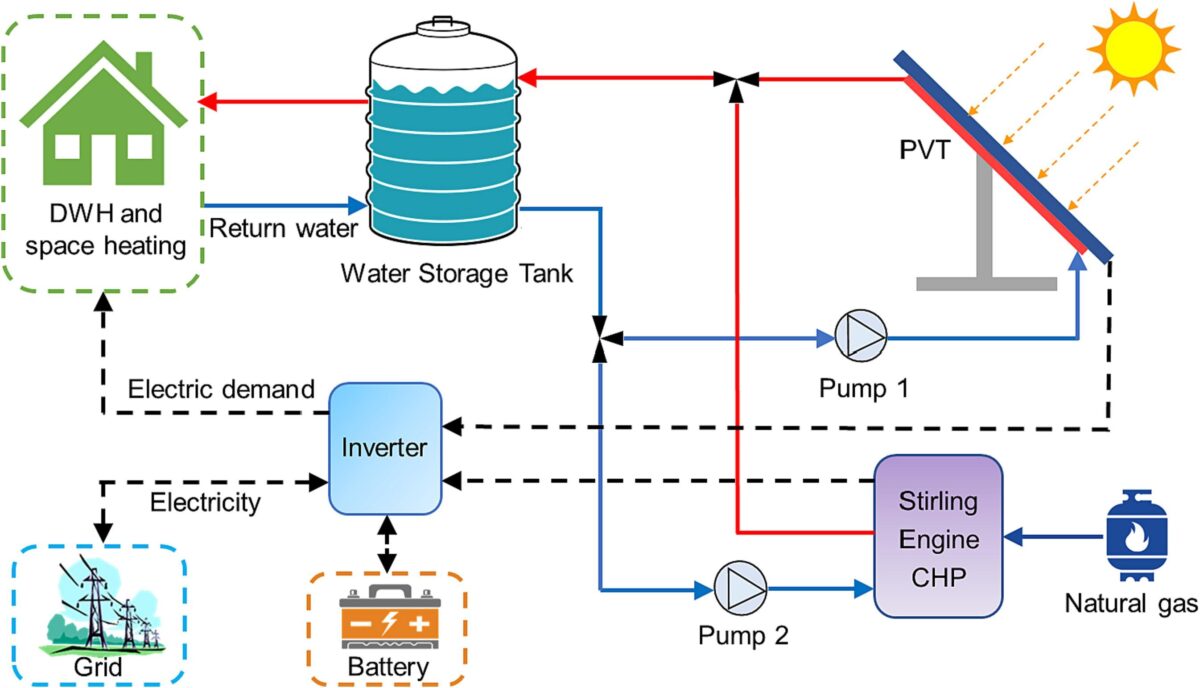
The hybrid system consists of 28 m2 PVT collectors, the Stirling engine, a hot water storage tank and a lead-carbon battery pack. It uses a primary pump to supply cold water to the PVT system and a secondary pump to supply cold water to the Stirling engine.
“The hot water coming from the SE unit is then mixed with hot water coming from the outlet of the PV-T collector and stored in a hot water tank,” the group said. “The stored hot water at a temperature of 60 C is then supplied directly to the homes to meet the demand for space heating and hot water.”
The system also generates alternating current via the SE unit’s alternator and direct current via the PVT collectors. Both are used to meet the household’s electrical demand via an inverter, with excess power being stored in the battery. Electricity from the grid can be used if both energy sources do not meet demand, and excess energy can be injected into the grid when the battery is fully charged.
The scientists tested the proposed system configuration for three different housing typologies: detached houses (DHs), semi-detached houses (SDHs) and terraced houses (MTHs). They found that the DH configuration achieves the highest total CO2 reduction2 emissions compared to SDH and MTH configurations, which depends on the larger PV-T system sizes used for the DH architecture.
“But when it comes to the CO achieved2 emission reduction rates, there is no major difference between different housing types, all within the range of 30% to 45%,” the researchers said. “This implies that the CO2 emission reduction of the proposed hybrid cogeneration system is to some extent not dependent on the housing type.”
The DH typology was also found to have the highest exergy efficiency.
“DHs have the lowest levelized electricity costs (LCOE) of GBP 0.622 ($0.78)/kWh, the lowest levelized heating cost (LCOEe) at £0.147/kWh, and the lowest levelized cost of total energy (LCOEeq, el) at £0.205/kWh,” the academics said, noting that the observed variations in these values should be attributed to the different exergy efficiencies achieved by the three housing types.
“However, the initial capital cost of such a system is high, mainly due to the SE unit and the photovoltaic-thermal (PVT) collector array, which currently acts as a barrier to widespread penetration,” Zhou added. If a further reduction in the initial investment, especially in the PVT collectors and the SE unit, can be achieved, it will significantly shorten the payback period and attract the widespread deployment of this technology.”
Their system details are available in “Techno-economic and environmental analyzes of a solar-assisted Stirling engine cogeneration system for different housing types in the UK”, which was recently published in Energy conversion and management.
Another research group at the University of Durham recently proposed a new design for thermoelectric heat pumps (TeHPs) that is said to leverage all the benefits that heat pump technology offers, especially when applied to residential buildings.
This content is copyrighted and may not be reused. If you would like to collaborate with us and reuse some of our content, please contact: editors@pv-magazine.com.
