

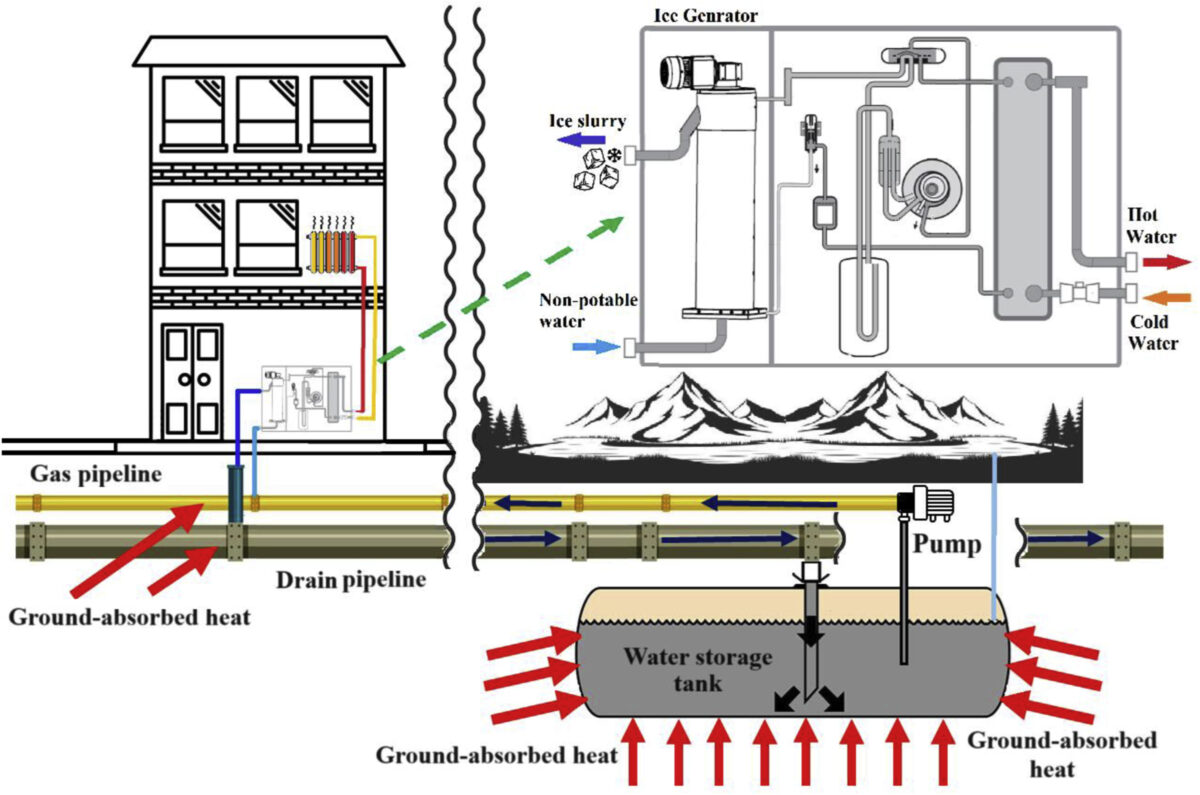
Scientists in the United Kingdom have designed an ice source heat pump system that uses existing gas pipelines to transport water. The system is designed to achieve a coefficient of performance of 4.77.
Researchers from the University of Nottingham in the United Kingdom have developed a residential ice heat pump system that uses repurposing existing gas pipes to transport water for ice heat pump operation.
“Our heat pump shows superior performance compared to all existing types, based on our claims. We have developed a prototype and are about to start testing its performance.corresponding author, Ramin Mehdipour, narrated pv magazine.
The research group performed a numerical simulation of the system on a house with a floor area of 98 m2, operating in the weather of the British city of Nottingham in 2021.
“The main problem with air source heat pumps (ASHPs) is their inability to provide sufficient heating during peak cold conditions, leading to increased electricity consumption and potential strain on the energy supply system,” the academics said. “Innovative solutions are key to overcoming challenges in the heating sector, and ice source heat pumps, by repurposing gas pipelines, offer a promising alternative that balances technological feasibility with environmental sustainability.”
Ice heat pumps are based on utilizing the latent heat produced when water freezes into ice. It cools the water until it freezes with the refrigerant R290 and uses the heat released to heat the house. The ice slurry produced is then discharged into the drainage system or stored for cooling in the summer.
The scientists also explained that ground temperatures in winter are higher than that of the external environment, which they say provides a stable heat source. “Our system is in line with the principles of geothermal heat pumps and can be seen as a central heat pump system,” says Mehdipour. “While other heat pumps experience performance losses during peak cold conditions, the ice source heat pump is specifically designed to operate under such conditions without disruption. Furthermore, it significantly reduces additional energy requirements for fluid circulation and water consumption, making it a suitable and efficient option.”
After designing the system, the team developed the associated equations based on thermodynamic principles and heat transfer. For reference, the systems were compared with heat pumps with a different heat source. They were heated by air, soil, lake and river water, tap water and waste water.
The analysis showed that the operating temperature of the heat pump corresponds to that of systems that use water at around freezing point. The coefficient of performance (COP) was found to be approximately 4.77.
“The system can reduce the water mass required for energy supply by up to 95% when using an ice slurry concentration of 70%,” the scientists said. “In practice, the ice heat pump requires approximately 36.7 times less water volume than traditional domestic heating systems, making it a very efficient alternative.”
Concluding the study, they also said that while other heat pumps may perform better in seasons with moderate temperatures, they can also have “significant” performance degradations in low temperatures, especially during cold spells.
Their findings were presented in “A comparative study of the performance of ice source heat pumps versus other heat source heat pumps: a case study in Great Britain”, published in Renewable energy.
This content is copyrighted and may not be reused. If you would like to collaborate with us and reuse some of our content, please contact: editors@pv-magazine.com.
