

A research team in Germany developed a dynamic model of spray cooling for floating PV systems that links thermal behavior, electrical performance and active cooling, and validated it against a 750 kW installation. Simulations in four climates have shown that spray cooling reduces module temperatures by up to 42% and improves energy yield by up to 3.8%, with the benefits highly dependent on local conditions.
Researchers from Germany’s FH Aachen University of Applied Sciences have developed a new dynamic model for spray cooling for floating PV systems (FPV).
“This work takes a system-level perspective on spray cooling for floating PV. While cooling itself is not new, the focus here is on a very simple and inexpensive sprinkler system that can realistically be implemented in practice,” said corresponding author Nico Oellers. pv magazine. “It combines detailed dynamic modeling with validation and applies the concept to different climates, demonstrating how strongly performance and optimal operation depend on location.”
He added that, in addition to cooling, spray cooling can also be useful for cleaning, snow prevention and fire protection on FPVs. “We are also planning large-scale, long-term testing to validate the results and explore additional use cases and environmental impacts, including impacts on the lake ecosystem and evaporation,” he added.
The dynamic model the team created combines thermal behavior, electrical performance and active cooling for floating PV systems. It takes various meteorological data as input and calculates solar heating, convective and radiative cooling, as well as evaporation and condensation effects to determine the module temperature. This temperature is then fed into an electrical model, where efficiency decreases as temperature increases.
When a defined temperature threshold is exceeded, the method activates a spray cooling model. This model quantifies the effects of both sensible and latent heat removal by water droplets impinging on the PV module, while simultaneously taking into account the electricity consumption of the water pump. Ultimately, it evaluates the net energy impact of cooling under different climatic conditions and operating scenarios.
Image: Solar-Institut Jülich (SIJ) of the FH University of Applied Sciences Aachen, Solar Energy, CC BY 4.0
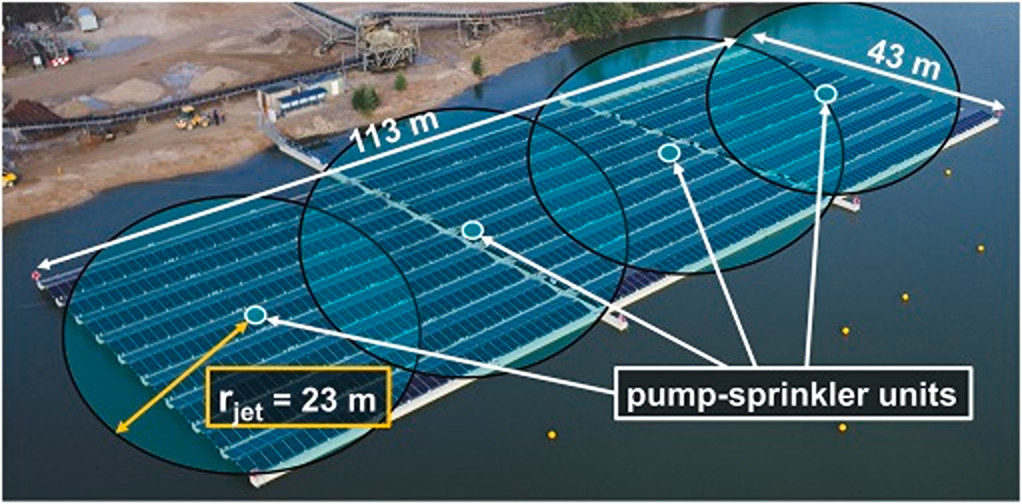
To validate the model, the team compared the results with measurements from a real floating PV installation in a water reservoir in Weeze, northwest Germany. The system has a total power of approximately 750 kW and uses 395 W modules with an efficiency of 19.5%. A spray cooling system was installed on a limited area of the factory in the central area, where the modules are located on both east and west faces. The setup consisted of a 2.2 kW submersible pump, connected to an agricultural sprinkler, operating at 2.3 bar, with a jet length of 23 m and a flow rate of 10.4 m³/h.
The model showed strong agreement with the experimental results, with a mean absolute deviation of 0.98 C. Subsequent annual simulations were performed for four climatologically different lakes: Lake Kinneret in Israel, Lake Garda in Italy, Lake Tahoe in the US and the entire Weeze facility.
“Across all sites, spray cooling significantly reduced module temperatures, with annual average reductions ranging from 12% to 22% and peak temperature reductions of up to 42%,” the researchers pointed out.
They also found that the magnitude of the cooling effect and resulting energy gain were highly dependent on climatic conditions, with the highest relative energy gain of 3.8% achieved at Lake Kinneret. In contrast, the cooler climates of Lake Garda and Lake Tahoe produced smaller relative gains of 2.7% to 3.1%, despite lower average module temperatures, while the temperate region of Weeze showed the smallest effect of 1.9%.
The research results were presented in “Dynamic modeling of spray cooling for floating solar photovoltaics with application in different climates”, published in Solar energy.
This content is copyrighted and may not be reused. If you would like to collaborate with us and reuse some of our content, please contact: editors@pv-magazine.com.
Popular content

