
Close Menu
  • News
  • Industry
  • Solar Panels
  • Commercial
  • Residential
  • Finance
  • Technology
  • Carbon Credit
  • More
    • Policy
    • Energy Storage
    • Utility
    • Cummunity
What's Hot

Fraunhofer ISE develops colored film technology for patterned solar panels

April 23, 2026

Thermoacoustic heat pumps are on the verge of commercial breakthrough – SPE

April 23, 2026

The federal court has halted Trump administration orders that hinder solar and wind energy development

April 23, 2026
Facebook X (Twitter) Instagram
Solar Energy News
Thursday, April 23
  • News
  • Industry
  • Solar Panels
  • Commercial
  • Residential
  • Finance
  • Technology
  • Carbon Credit
  • More
    • Policy
    • Energy Storage
    • Utility
    • Cummunity
Solar Energy News
Home - News - DGIST improves the performance of quantum dot solar cells
News

DGIST improves the performance of quantum dot solar cells

solarenergyBy solarenergyOctober 4, 2024No Comments2 Mins Read
Facebook Twitter Pinterest LinkedIn Tumblr Email
Share
Facebook Twitter LinkedIn Pinterest Email

DGIST improves the performance of quantum dot solar cells


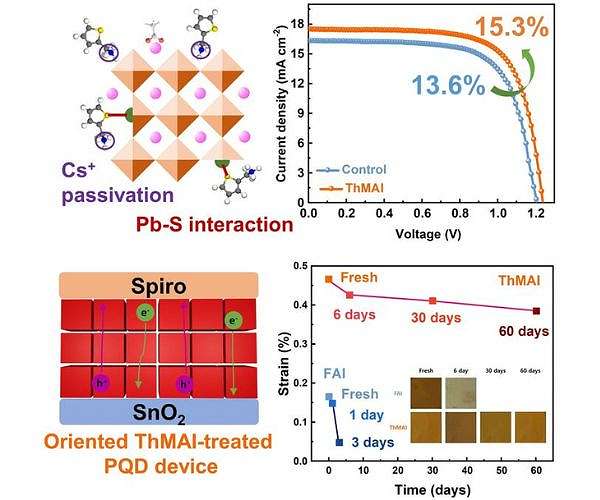
A research team led by Professor Jongmin Choi from DGIST’s Department of Energy Science and Engineering, in collaboration with Professor Tae Kyung Lee from Gyeongsang National University and Professor Younghoon Kim from Kookmin University, has developed a new method that improves the performance and longevity of perovskite improves significantly. quantum dot solar cells. Their innovative approach addresses a key problem: surface deformations on quantum dots that hinder the efficiency of solar cells.

Perovskite quantum dots are widely considered essential for the next generation of solar cells due to their high light-to-electricity conversion efficiency and scalability. However, the process of replacing the “ligands” on their surface often causes deformations, similar to crumpled paper, that deteriorate the performance of solar cells.

The research team tackled this problem by introducing short ligands that tightly grip both sides of the quantum dots. This method effectively repairs the deformed surface of the quantum dot, which is similar to the process of flattening crumpled paper. By making the surface smoother, they significantly reduced defects and improved both the performance and stability of the solar cells. Energy conversion efficiency increased from 13.6% to 15.3%, and the cells maintained 83% of their performance over 15 days, marking a major advance in solar cell technology.

“Through this research, we can minimize surface defects on the quantum dots and stabilize their surfaces by reusing these amphiphilic ligands, significantly improving the efficiency and stability of the solar cells,” explains Professor Jongmin Choi. He also noted that the team plans to expand this approach to other photoelectric devices in the future.

See also  Service provider Energyaid is planning to support leaving customers of Titan Solar Power

This study, a joint effort of DGIST, Gyeongsang National University and Kookmin University, was supported by the National Research Council of Science and Technology, the DGIST R and D Program and the New Faculty Research Foundation of Gyeongsang National University. The findings were published in the ‘Chemical Engineering Journal’ on September 15, 2024.

Research report:Versatile anchoring ligands for uniform orientation and enhanced cubic phase stability of perovskite quantum dots


Source link

cells DGIST Dot improves performance Quantum solar
Share. Facebook Twitter Pinterest LinkedIn Tumblr Email
solarenergy
  • Website

Related Posts

Fraunhofer ISE develops colored film technology for patterned solar panels

April 23, 2026

The federal court has halted Trump administration orders that hinder solar and wind energy development

April 23, 2026

Solar energy’s rebound effect could increase European electricity demand by 5% by 2050 – SPE

April 23, 2026
Leave A Reply Cancel Reply

Don't Miss
News

Generac has tapped to provide microgrid backup power for water utilities in California

By solarenergyOctober 23, 20240

Generac Holdings announced that it has been selected to begin negotiations by the Department of…

The impact of seasonal, meteorological factors on the performance of PV installations – SPE

May 7, 2024

Carrier launches new air-to-water heat pumps for commercial applications-PV Magazine International

August 19, 2025

WoodMac predicts 3.8 TW of new solar energy by 2033 – SPE

July 8, 2024
Stay In Touch
  • Facebook
  • Twitter
  • Pinterest
  • Instagram
  • YouTube
  • Vimeo
Our Picks

Fraunhofer ISE develops colored film technology for patterned solar panels

April 23, 2026

Thermoacoustic heat pumps are on the verge of commercial breakthrough – SPE

April 23, 2026

The federal court has halted Trump administration orders that hinder solar and wind energy development

April 23, 2026

Zendure launches battery ranges for residential PV – SPE

April 23, 2026
Our Picks

Fraunhofer ISE develops colored film technology for patterned solar panels

April 23, 2026

Thermoacoustic heat pumps are on the verge of commercial breakthrough – SPE

April 23, 2026

The federal court has halted Trump administration orders that hinder solar and wind energy development

April 23, 2026
About
About

Stay updated with the latest in solar energy. Discover innovations, trends, policies, and market insights driving the future of sustainable power worldwide.

Subscribe to Updates

Get the latest creative news and updates about Solar industry directly in your inbox!

Facebook X (Twitter) Instagram Pinterest
  • Contact
  • Privacy Policy
  • Terms & Conditions
© 2026 Tsolarenergynews.co - All rights reserved.

Type above and press Enter to search. Press Esc to cancel.