

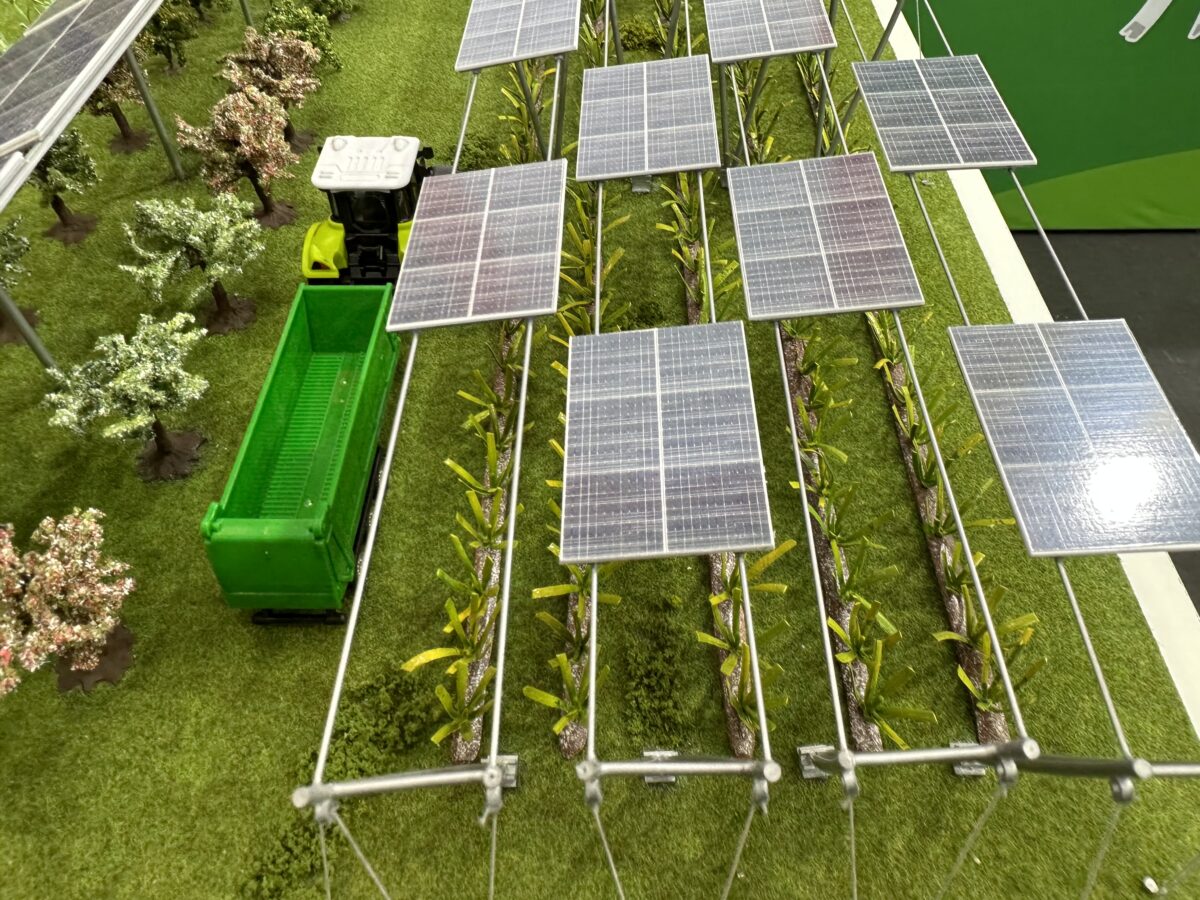
Researchers conducted a field study over two growing seasons, growing different types of vegetables under three types of modules with 40%, 5% and 0% transparency. Their work is the first replicated research experiment evaluating module transparency in an irrigated vegetable field environment.
Scientists from Colorado State University have conducted field research into the growth of vegetable crops under PV modules with varying transparency. The vegetables are grown under thin film, semi-transparent cadmium telluride (St-CdTe) modules with a transparency of 40%, bifacial monocrystalline silicon (BF-Si) modules with a transparency of 5%, and opaque polycrystalline silicon (O-Si) . ) modules with a transparency of 0%.
“Semi-transparent PV (STPV) module technology has emerged as a potential solution to mitigate the negative effects of dense shade in cropping systems while maintaining high module density,” the academics said. “To our knowledge, this is the first replicated research experiment evaluating module transparency types in an irrigated vegetable field environment.”
The experiment was conducted over two growing seasons, 2020 and 2021. The study site was in Fort Collins, Colorado, USA, in a field designated for research. In total, the growth of six vegetables was tested: jalapeño peppers, peppers, lettuce, summer squash, Tasmanian chocolate tomatoes and red racer tomatoes.
“There were three planted rows spread across the entire site – north, center and south,” the group explained. “Lettuce, peppers and tomatoes were planted in two staggered sub-rows in 0.9 m beds, covered with black plastic mulch in the northern and southern rows. Pumpkins were planted exclusively in the middle row both years with a spacing of 4 feet on center.”
As for the PV modules, the scientists used three of each type. They were installed in a fixed position of 35 degrees south, with the bottom of the modules 1,220 mm above the ground and the rear at a height of 2,360 mm. The ST-CdTe modules were rated at 57 W, the BF-Si was 360 W, and the O-Si was 325 W.
“Each of the twelve crop subplots, including both PV arrays and control plots, spanned a width of 4.3 meters, with a distance of 4.3 meters between adjacent subplots,” the researchers said. “Thanks to the single pole mounting configuration, the shadow of the modules moved throughout the day. This meant the crops received direct sunlight early and late in the day, with maximum shade during the peak hours of the day and directly under the modules.”
According to the results, under all three module types, summer squash showed significantly lower yields than the control plot, regardless of the module transparency type. While in the control chart, under full sun, the pumpkin yielded 5.1 kg per plant, it grew 3.2 kg in the BF-Si scenario, 3.2 kg in the O-Si scenario and 4.1 kg in the ST-CdTe scenario.
The other vegetables had equal or higher average yields than the control under the 40% transparent ST-CdTe treatment, but without statistically significant differences. The jalapeño peppers yielded 155 grams per plant in full sun, 161 grams in the BF-Si, 155 grams in the O-Si and 162 grams in the ST-CdTe, while the peppers yielded 295 grams per plant in full sun. 294 g in the BF-Si, 278 g in the O-Si and 346 g in the ST-CdTe.
The lettuce weight per head was 105 g in full sun, 126 g in the BF-Si, 111 g in the O-Si and 129 g in the ST-CdTe. The Tasmanian chocolate tomatoes had an average of 926 grams per plant in full sun, 1,060 grams in the BFSi, 1,069 grams in the O-Si and 1,278 grams in the ST-CdTe. Finally, the red racer tomatoes had 867 g per plant in full sun, 733 g in the BF-Si, 903 g in the O-Si and 962 g in the ST-CdTe.
“The optimization of the agricultural PV array with semi-transparent PV modules could increase agricultural production while maintaining the additional protection of a powered canopy in traditional APV systems,” the researchers concluded. “More research is needed to better understand the economic tradeoffs between increased module transparency compared to vegetable crop production, while also taking into account the increased energy yield from module duality.”
Their findings were presented in “Growth of vegetable crops under photovoltaic (PV) modules with different transparencies”, published in Heliyon.
This content is copyrighted and may not be reused. If you would like to collaborate with us and reuse some of our content, please contact: editors@pv-magazine.com.
