
Close Menu
  • News
  • Industry
  • Solar Panels
  • Commercial
  • Residential
  • Finance
  • Technology
  • Carbon Credit
  • More
    • Policy
    • Energy Storage
    • Utility
    • Cummunity
What's Hot

Dutch solar owners asked to switch off during peak periods to ease the distribution crisis

June 7, 2026

The hydrogen flow: Toyota demonstrates its racing prototype on liquid hydrogen

June 7, 2026

Era of electrification exposing Australia’s weakest link

June 6, 2026
Facebook X (Twitter) Instagram
Solar Energy News
Sunday, June 7
  • News
  • Industry
  • Solar Panels
  • Commercial
  • Residential
  • Finance
  • Technology
  • Carbon Credit
  • More
    • Policy
    • Energy Storage
    • Utility
    • Cummunity
Solar Energy News
Home - Technology - The NTU team finds a new way to make perovskite cells greener
Technology

The NTU team finds a new way to make perovskite cells greener

solarenergyBy solarenergyMay 6, 2024No Comments3 Mins Read
Facebook Twitter Pinterest LinkedIn Tumblr Email
Share
Facebook Twitter LinkedIn Pinterest Email

Research led by scientists from Nanyang Technological University, Singapore (NTU Singapore) announced the findings of using non-toxic metals with a new approach to fabricate the capping layer of perovskite solar cells, making the cells more environmentally friendly while maintaining high conversion efficiency.

Since the first perovskite-based solar cell was published in 2009scientists have strived to discover new materials and manufacturing techniques to improve the efficiency and stability of perovskite cells.

Another cause that hinders commercialization is the environmental impact of the toxic elements in the cells. Perovskites can decompose when they react with moisture and oxygen, are exposed to light and heat, or when used for extended periods of time. When the cell is damaged or discarded, the toxic heavy metal from the perovskite material and the cap layer (coated on the perovskite layer to protect the cell from environmental stress and to improve its performance) can threaten the environment.

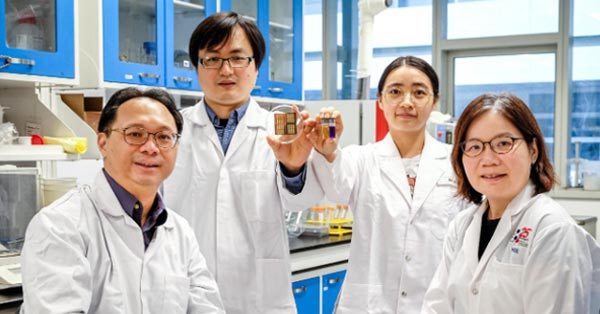
NTU team of the zinc-based capping layer perovskite cell research
The NTU Singapore scientists who led the research.

Scientists from NTU Singapore discovered that a zinc-based compound PEA2ZnX4, synthesized using a new approach called the complete precursor (FP) method, can create a lead-free capping layer for the perovskite cell. .

When the traditional half-precursor (HP) method is used, it is necessary to draw up lead ions from the underlying perovskite layer to form the protective cap layer. However, the FP method allows the chemicals in the composite solution to react with each other directly on the surface of the perovskite layer, which is more effective.

Structure of perovskite cell with zinc-based capping layerStructure of perovskite cell with zinc-based capping layer
Left: the molecular structure of perovskite (blue) with the zinc-based coating (green). Right: the FP process the researchers used to apply the zinc-based coating to the perovskite layer. Credit: NTU Singapore

Using the FP method, the scientists created a prototype 1-inch by 1-inch perovskite cell capped with the zinc-based compound. After examining with electron microscopy and spectroscopy, they found that the zinc-based capping layer did not affect the electrical properties of the underlying perovskite layer, while it helped to cover defects on the surface of the perovskite layer and improve its light-collecting capabilities. In experiments with simulated sunlight, the prototype cell was able to convert 24.1% of light into electricity, close to the highest record achieved by perovskite solar cells to date.

See also  US Startup offers tinoxide, nickel oxide - materials for flexible perovskite solar cells, modules - PV Magazine International

The scientists also say that the new method contributes to efforts to make the perovskite layer more environmentally friendly, stable and efficient, as it does not require extracting lead ions from the perovskite layer to make the traditional lead-based capping layer, opening up new possibilities opens up the use of other materials to reshape both the perovskite and capping layers, thereby optimizing overall cell performance.

The Institute of Materials Research and Engineering (IMRE) of the Agency for Science, Technology and Research (A*STAR) in Singapore also participated in the study.

Details of the study can be found in Nature Energy in February 2023. The scientists are working on scaling up the method to manufacture full-size cells.


Source link

cells finds greener NTU perovskite team
Share. Facebook Twitter Pinterest LinkedIn Tumblr Email
solarenergy
  • Website

Related Posts

Storing sustainable energy with compressed air in district heating pipelines – SPE

May 26, 2026

Spanish grid operator validates tower resistance to cascade failures – SPE

May 26, 2026

Research shows POLO back-junction solar cells could outperform PERC in terms of cost in Europe – SPE

May 26, 2026
Leave A Reply Cancel Reply

Don't Miss
News

Organic radical breakthrough can cause a revolution in the efficiency of solar energy

By solarenergyOctober 7, 20250

Organic radical breakthrough can cause a revolution in the efficiency of solar energy In a…

“My female leader was a great mentor and cheerleader, providing invaluable guidance” – SPE

January 26, 2025

Former Army Depot features the first community solar project of its kind

October 3, 2024

Field Survey Protocol For Monitoring PV – Achter breakdown – PV Magazine International

March 21, 2025
Stay In Touch
  • Facebook
  • Twitter
  • Pinterest
  • Instagram
  • YouTube
  • Vimeo
Our Picks

Dutch solar owners asked to switch off during peak periods to ease the distribution crisis

June 7, 2026

The hydrogen flow: Toyota demonstrates its racing prototype on liquid hydrogen

June 7, 2026

Era of electrification exposing Australia’s weakest link

June 6, 2026

‘Come out from behind your screen, our industry is ultimately about people’

June 6, 2026
Our Picks

Dutch solar owners asked to switch off during peak periods to ease the distribution crisis

June 7, 2026

The hydrogen flow: Toyota demonstrates its racing prototype on liquid hydrogen

June 7, 2026

Era of electrification exposing Australia’s weakest link

June 6, 2026
About
About

Stay updated with the latest in solar energy. Discover innovations, trends, policies, and market insights driving the future of sustainable power worldwide.

Subscribe to Updates

Get the latest creative news and updates about Solar industry directly in your inbox!

Facebook X (Twitter) Instagram Pinterest
  • Contact
  • Privacy Policy
  • Terms & Conditions
© 2026 Tsolarenergynews.co - All rights reserved.

Type above and press Enter to search. Press Esc to cancel.