

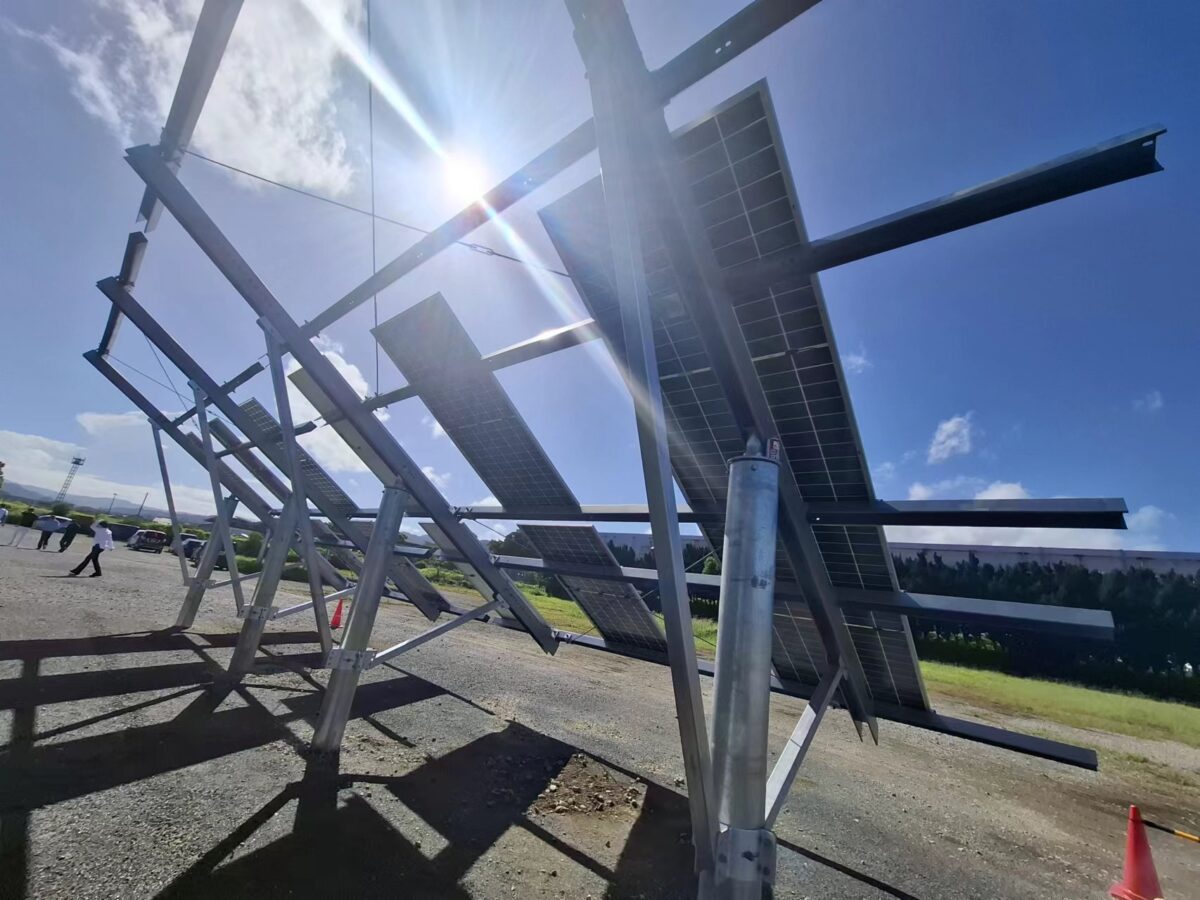
JinkoSolar and Trina Solar separately reported that field testing shows that tunnel oxide passivated contact (TOPCon) solar panels outperform p-type back-contact PV modules in terms of monthly power generation.
Chinese solar panel manufacturers JinkoSolar and Trina Solar each published white papers this week demonstrating that their TOPCon panel technologies offer superior energy yield compared to back-contact (BC) module technologies.
In its case study, JinkoSolar explained that tests took place at its factory in Kagoshima, Japan, from September 12 to October 11, with the results confirmed by Germany’s TÜV Nord.
“The TOPCon product showed an average energy yield of 2.22% and up to 6.95% higher than its p-type back contact counterpart,” the company said in a statement. “In recent months, the photovoltaic industry has debated the technical route of xBC technologies. The manufacturers promised more rated power and efficiency at the front because there is no grid line at the front of the product. And as they make their way into a number of pilot projects, we can see how these claims play out in practice under different climate conditions.”
The test involved three modules: a 575W double-glass n-type TOPCon module from JinkoSolar, a 580W double-glass p-type back-contact (BC) module and a 605W single-glass n-type BC module. The identities of the two BC module manufacturers have not been disclosed. All modules were installed at a tilt angle of 20 degrees and 1 meter above the ground.
Using a CR1000X system, JinkoSolar experts found that the TOPCon module generated 136.86 kWh/kW, while the p-type BC produced 133.87 kWh/kW and the n-type BC 129.98 kWh/kW yielded.
“Thanks to its higher bifaciality and lower temperature coefficient, when normalized by the power of each module, the module achieved an efficiency that was 2.22% higher than the p-type BC and 5.29% higher than the n-type BC ,” said JinkoSolar. “On sunny and cloudy days during this period, the energy yield of the TOPCon modules remains consistently 2% to 3% higher than that of p-type BC modules and 5% to 6% higher than that of n-type BC modules. ”
The TOPCon module reportedly achieved the highest performance ratio among the three products.
“TÜV Nord has measured a performance ratio of 94.19% for the TOPCon module, while the other two lag slightly behind: 91.99% for p-type BC and 89.29% for n-type BC,” the white paper notes .
In a separate report, Trina Solar noted that its TOPCon modules deliver an average power generation gain of 3.15% per watt over XBC modules, with a relative monthly gain of up to 3.4%.
The company conducted its measurements at its test field in Changzhou, Jiangsu Province, China, from July 16 to September 10. It compared the performance of its TOPCon Vertex N 600W bifacial double-glass modules with 620W bifacial double-glass TBC modules from an unnamed supplier.
The panels were mounted at a tilt angle of 23 degrees on cement ground with approximately 30% reflectivity, 0.5 meters above the ground. An IV tracker collected data on energy generation.
“TOPCon modules were found to be significantly superior in low irradiation conditions, such as early morning and late evening, after analyzing energy generation data at different times of the day,” said Trina Solar. “From 7:00 AM to 8:00 AM, TOPCon’s power generation per watt was 6.9% higher than that of TBC, and from 5:00 PM to 7:00 PM, the relative gain was 8.3% to 8.4%. This result is consistent with previous field tests showing that TOPCon modules perform approximately 5% better than back-contact technologies at low irradiation.”
The company also said that TOPCon’s higher bidirectionality is the key factor for its “superior” power generation. “TOPCon modules exhibit a 2.6% advantage in power generation over TBC modules, even at midday when sunlight is strongest, which can be attributed to their dual-sidedness,” the report said. “These findings are consistent with results from both the National Photovoltaic and Energy Storage Experimental Platform and the National Center of Inspection on Solar Photovoltaic Products Quality.”
This content is copyrighted and may not be reused. If you would like to collaborate with us and reuse some of our content, please contact: editors@pv-magazine.com.
