

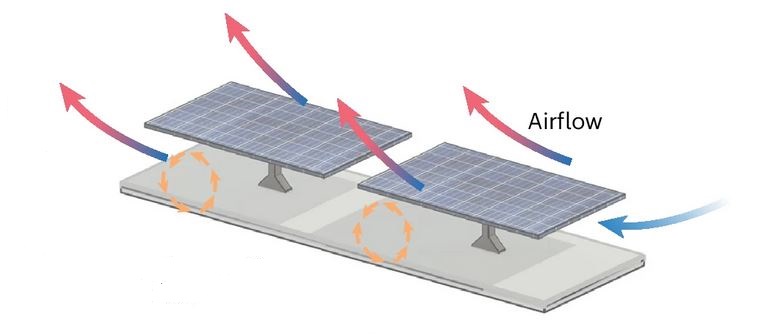
New research from India shows that rooftop PV systems can have ‘unintended’ consequences for temperatures in urban environments. For example, rooftop arrays can potentially reduce nighttime temperatures by up to 0.6 C.
An international group of scientists has created a new model for assessing rooftop photovoltaic solar panels (RPVSPs) in urban microclimates.
The module uses the latest Weather Research and Prediction (WRF) model, which integrates the Building Energy Model (BEM) and Building Effect Parameterization (BEP). The model was validated against ten observation stations in Kolkata, India, using experimentally validated models.
“Although existing literature reports on the impact of RPVSP on the urban environment, most are based on in situ field experiments or building-scale simulations, lacking a comprehensive multi-city analysis. These studies also ignore convective heat transfer between the roof surface and the back of solar panels,” the academics said. “Our research addresses these gaps by incorporating new parameterizations for RPVSPs, including convective heat transfer, resulting in better aligned results with other studies that incorporate similar considerations.”
The combined approach, called the WRF/BEP + BEM model, can calculate the heat exchange, momentum, humidity and turbulent kinetic energy flux between buildings and the outdoor environment under stable atmospheric conditions. It was initially tested in the Indian city of Kolkata and then validated in Sydney, Australia; Austin, Texas, USA; Athens, Greece; and Brussels, Belgium, to ensure that findings are not limited to a specific climate zone.
“Five experiments have been conducted to assess the regional impact of extensive deployment of RPVSPs during the current heat wave month in Calcutta. The control simulation used a roof albedo of 0.15 and no RPVSPs,” the group explained. “The experiments examined RPVSP scenarios with coverage fractions of 0.25, 0.50, 0.75 and 1.0 on city rooftops. Default RPVSP parameters, including albedo, conversion efficiency, and emissivity, were set to 0.11, 0.19, and 0.95, respectively.
According to data collected in Calcutta, RPVSPs can increase surface air temperature by up to 1.5 C during the day as they absorb about 90% of solar energy and convert up to about 20% of it into electricity, while the rest contributes to their solar energy. warming. At night, on the other hand, full PV coverage in the city can reduce the maximum surface air temperature by up to 0.6 C at night. During peak hours, the roof surface temperature would increase by a maximum of 3.2 C and have an average cooling of 1.4. at night.
Surface air temperatures were similar across the board. Sydney experienced a cooling of 0.8 C at night and a rise of 1.9 C during the day; Austin showed a cooling of 0.7C and a rise of 1.8C, while Athens had 0.4C and 1.2C respectively. The results from Brussels showed a nighttime cooling of 0.3 C and a daytime increase of 1.1 C.
“Our research also shows that rooftop photovoltaic panels significantly alter urban surface energy budgets, surface meteorological fields, urban boundary layer dynamics, and sea breeze circulation,” the group added. “High urban temperatures due to the installation of RPVSPs lower atmospheric mixing and increase the planetary boundary layer (PBL) height by up to 615.6 m, reducing ground-level pollution.” PBL represents the lowest part of the atmosphere, which is directly influenced by the Earth’s surface.
The findings were presented in the study “Rooftop photovoltaic solar panels heat and cool cities,” published in Natural cities. The study was conducted by researchers from India’s University of Calcutta, the Indian Institute of Technology Kharagpur, Jadavpur University, the US Massachusetts Institute of Technology (MIT), the University of Texas at Austin, the Chinese Academy of Sciences and the Australian University or New South Wales.
This content is copyrighted and may not be reused. If you would like to collaborate with us and reuse some of our content, please contact: editors@pv-magazine.com.
