

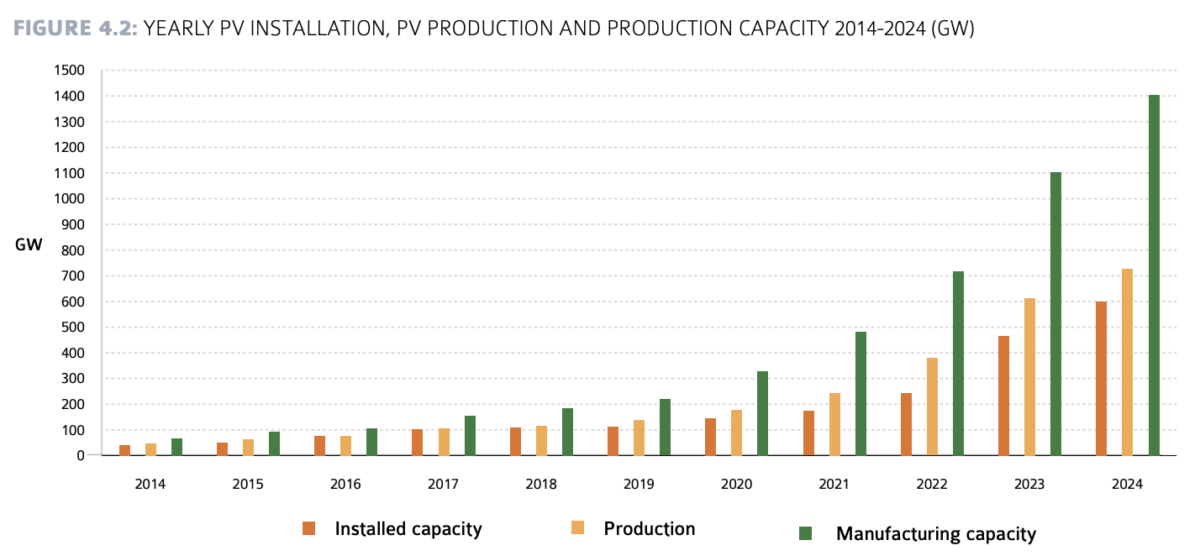
According to the IEA-PVPS, the global solar market will set annual records in 2024 in terms of solar installations, solar module production and solar module production capacity. Trends in PV applications 2025 report.
The report highlights that between 553 GW and 601 GW of solar power was added globally last year, pushing the cumulative capacity past 2,260 GW.
About 373 GW, or 62%, of last year’s installations were centralized systems, defined as installations larger than a few MW that supply electricity to the grid. In the distributed segment, another 228 GW was added, both for installations of less than a few MW and for installations connected to a consumption point. The share of utility-scale installations represented approximately 57% of cumulative installed capacity in 2024 and remained stable compared to 2023.
China accounted for almost 60% of all new installations, adding between 309 GW and 357 GW of solar power. IEA-PVPS says this market dominance is comparable to Germany’s role in the mid-2000s, adding that its long-term impact remains difficult to assess. After China, the United States installed 47 GW of solar energy, followed by India (32 GW) and Germany (17.2 GW). IEA-PVPS says nearly 35 countries now operate GW-scale annual markets, while more than 40 countries have more than 4 GW of cumulative solar capacity.
In the foreword to the report, IEA PVPS chairman Daniel Mugnier and Task 1 manager Gaëtan Masson wrote that the solar sector’s expansion in 2024 continued alongside economic turbulence, with extreme module overcapacity that began in 2023 translating into unsustainably low prices that threatened the viability of manufacturers in all regions. “In 2024, signs of price stabilization began to appear towards the end of the year as concerted efforts were made to work on manufacturers’ sustainability,” the pair added.
Global production of solar panels amounted to 728 GW in 2024. This represents an increase of 18.5% from 2023, representing a significant slowdown compared to the 61.7% annualized growth observed between 2022 and 2023.
China accounted for 86.4% of global solar panel production last year. Outside China, IEA-PVPS says production was modest but still notable. India produced 24 GW of PV modules, followed by the US with 23 GW, Vietnam with about 20 GW, Thailand with about 10 GW and Malaysia with about 7 GW.
IEA-PVPS noted changes in the components and configurations of PV modules last year, including a growing share of bifacial modules. According to the China Photovoltaic Industry Association, 77.6% of crystalline silicon PV modules manufactured in China were bifacial, in an effort to meet market demand for higher energy yields.
The report also notes that total global solar panel production capacity was 1,405 GW annually, of which 83% was in China.
IEA-PVPS highlights that many solar panel manufacturers faced financial pressure last year, with a growing number of producers reporting net losses in their 2024 financial results.
The report adds that these challenging market conditions continued until mid-2025. “As of July 2025, several major manufacturers were reassessing their investment plans and production strategies,” IEA-PVPS said. “In response, some companies are shifting their focus to energy storage systems and integrated solutions companies in an effort to diversify their revenue streams and stabilize their operations.”
Elsewhere, global solar wafer production totaled 804 GW in 2024, an increase of 18% from 2023, with 97% of that in China. The report said Vietnam, Thailand and Malaysia began attracting wafer investments from investors looking to avoid tariffs on Chinese products entering the US, but added production volumes remained relatively limited in size.
Global wafer production capacity rose 43% year-on-year to 1,395 GW per year in 2024, with China accounting for 1,349 GW of the total.
IEA-PVPS says that almost all crystalline silicon wafers used in solar cell production last year were single crystalline (sc-Si). Within this category, n-type wafers increased their market share from 30% in 2023 to 70% in 2024, becoming the dominant technology.
Meanwhile, global solar cell production, including thin-film technologies, reached 753 GW in 2024, an annual growth rate of 17%, down from the 63% increase observed in 2023.
Total solar cell production capacity worldwide reached 1,427 GW annually last year, with China accounting for 91%. IEA-PVPS says the geographic distribution of cell production is expected to diversify in the near future, highlighting upcoming expansions in the US and India.
The report also noted a major shift in solar cell technology last year. While p-type PERC cells enjoyed the largest market share in 2023 with around 64%, their share fell to around 20% in 2024. They were overtaken by TOPCon-type crystalline silicon cells, whose market share rose from around 30% in 2023 to 70% in 2024. Meanwhile, other technologies, including heterojunction and back-contact cells, each remained below the 5% market share.
The report also highlights ongoing work on emerging technologies such as perovskites and tandem technologies, but says large-scale commercial production has yet to begin.
The trends report is part of IEA-PVPS Task 1, which focuses on market and sector analysis.
This content is copyrighted and may not be reused. If you would like to collaborate with us and reuse some of our content, please contact: editors@pv-magazine.com.
