

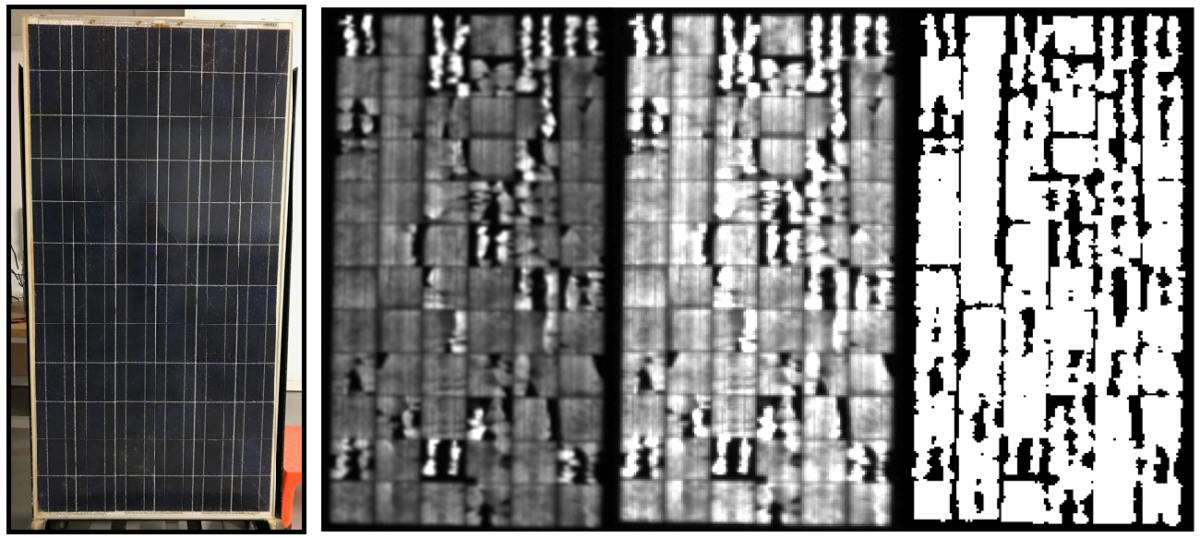
An international research team used high-resolution electroluminescence imaging to quantify type-C cracks in 100 PV modules after 11 years of operation, linking crack distribution to real-world power loss. Concentrated cracks in individual cells were found to cause disproportionately high losses, highlighting the importance of cell-level crack analysis for effective PV maintenance.
An international team of researchers has performed a quantitative assessment of the power loss of PV modules affected by type-C cracks using electroluminescence (EL) imaging.
“This study uses high-resolution EL imaging and automatic crack segmentation to quantify type-C cracks in a sample of 100 PV modules from two manufacturers, correlating these measurements with power losses at the module, substring, and cell levels,” said corresponding author Jose Antonio Clavijo-Blanco. pv magazine. “Statistical characterization of power losses was performed both for the sample as a whole and per manufacturer.”
The type-C cracks – defined as cracks that create completely disconnected dark areas, leading to power loss and possibly hotspots – were quantified in PV crystalline-silicon (c-Si) modules that have been in use for 11 years.
A key finding of the study was that concentrated type-C cracks in individual PV cells cause significantly higher power losses than the same total crack area spread evenly across the panel. “This shows that localized damage at the cell level is the main cause of performance degradation, highlighting the importance of analyzing cracks at the cell scale rather than just at the module or substring level,” Clavijo-Blanco emphasizes.
The 100 PV modules came from a 2.85 MW solar power plant in southern Spain. Half of the modules tested were from an undisclosed manufacturer 1, with capacities ranging from 210 W to 225 W, while the other half were 270 W modules from an undisclosed manufacturer 2. Each module from manufacturer 1 had 60 cells and each module from manufacturer 2 had 72 cells. All modules were equipped with three bypass diodes, which electrically divide the modules into three sections.
The modules were examined using a practical decision-making framework consisting of three phases, namely image capture, image processing and image analysis. The first phase consists of cleaning the module, mounting it safely and then distorting and capturing EL images in a dark environment. The second phase includes grayscale normalization, thresholding, and raster-based segmentation.
Image: University of Cadiz
Finally, in the final stage, the type-C areas are quantified and the power loss is estimated via a simplified mismatch model. The scientists then use the weighted average degradation rate (WADR) to accept or reject a module: a sample with a WADR of less than 11% is considered suitable, a sample with a WADR between 11% and 20% is considered degraded, and a module with a WADR of more than 20% is considered unstable.
“The combination of quantitative crack analysis and operational decision making in a real-world module sample represents a significant advance in PV monitoring and maintenance strategies,” said Clavijo-Blanco. “Differences observed between PV modules from different manufacturers suggest that installation or operational factors may influence degradation patterns.”
The analysis showed that 62% of Manufacturer 1’s modules were suitable, 22% were degraded and 8% were unstable; for Manufacturer 2, 30% were suitable, 60% were aborted and 10% were unsuitable. Further statistical analysis of the sample indicates that the distribution of the generalized extreme value best fits the results of the power loss estimation, with an average of 12.77%.
“Finally, from a corrective maintenance perspective, it was confirmed that a single crack affecting more than 20% of an individual cell can lead to power losses of more than 20%, classifying the module as unsuitable,” the team explains. “This finding highlights the importance of evaluating the spatial distribution of Type-C cracks, as concentrated cracks in a single cell can lead to significant losses for the entire module.”
The results of the tests were presented in “Quantitative Assessment of PV Modules Affected by Type-C Cracks Using Electroluminescence Imaging”, published in Solar energy. Researchers from Spain’s University of Cádiz and Tanzania’s University of Dodoma took part in the study.
“By combining expertise from European and African institutions, the research not only strengthens international cooperation in PV research, but also promotes knowledge exchange and capacity building across continents,” concludes Clavijo-Blanco. “Future research will focus on improving the accuracy of power loss estimation, taking into account additional parameters such as temperature effects, and expanding the analysis to other crack types and EL-detectable defects. Furthermore, we plan to implement machine learning techniques for automatic detection and classification of type-C cracks.”
This content is copyrighted and may not be reused. If you would like to collaborate with us and reuse some of our content, please contact: editors@pv-magazine.com.
Popular content

