

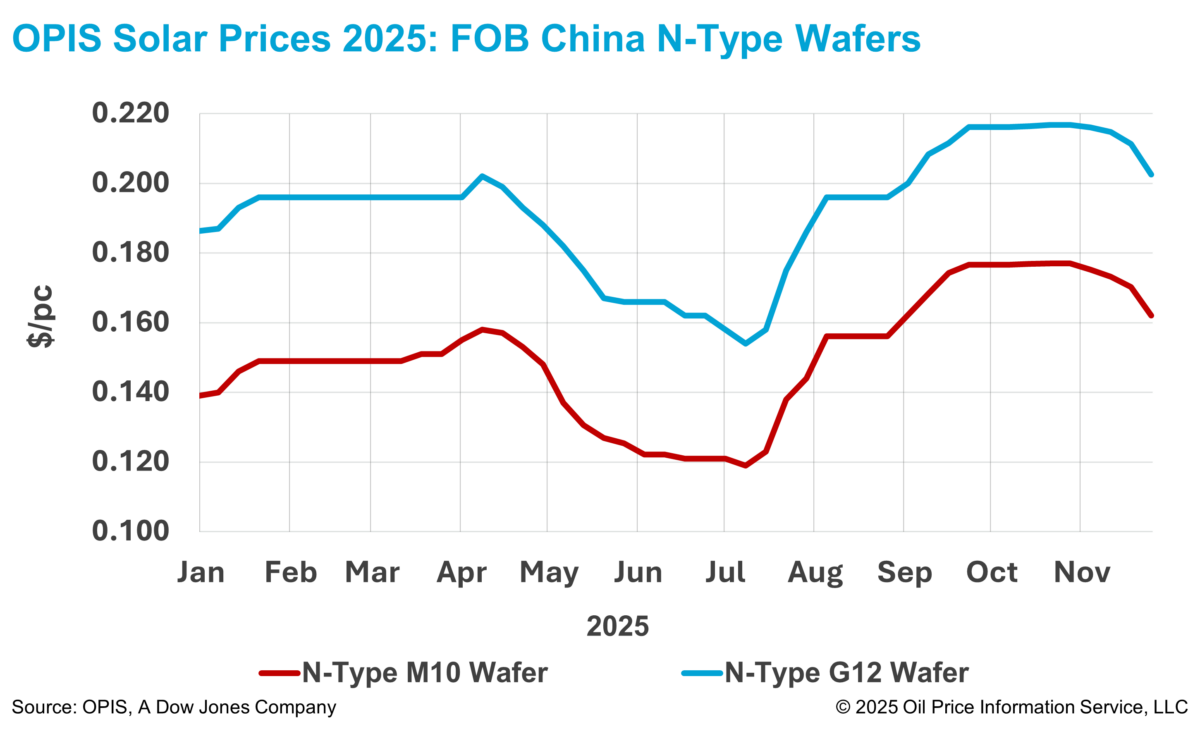
In a new weekly update for pv magazineOPIS, a Dow Jones company, provides a brief overview of the major price trends in the global PV industry.
Prices of N-type wafers have continued to decline for the fourth week in a row. According to the OPIS Solar Weekly Report published on November 25, FOB China prices for M10 wafers were reported at $0.162 per unit (pc), down 4.71% week-on-week, while G12 wafers were at $0.202/pc, down 4.27% week-on-week.
Since late October, M10 and G12 wafer prices have shown a cumulative decline of approximately 8.5% and 6.6%, respectively.
The current downward trend is driven by continued weakness in end-market demand and growing concerns among manufacturers about potential inventory build-up. With year-end cash flow needs increasing, many manufacturers have opted to lower prices to speed up shipments. A trading source noted that wafer makers have been operating at a loss for more than two years, making cash preservation and liquidity management their top priorities.
Another industry insider highlighted that wafers, unlike polysilicon, face stricter storage requirements due to their sensitivity to environmental conditions. Long-term storage can compromise wafer quality, and rapid shifts in preferred wafer sizes in the downstream market further reduce manufacturers’ tolerance for inventory risk. As a result, wafer inventory is highly susceptible to depreciation, prompting manufacturers to minimize inventory levels.
Feedback from multiple market participants indicates that wafer manufacturers have reduced production to varying degrees, with current operating rates ranging from around 50% to just over 70%.
One source noted that even a specialty manufacturer, which previously had sales of around 80% thanks to strong OEM order volumes, has reduced operations following a drop in OEM demand, with further cuts expected. The sharp decline in OEM orders is seen as a clear signal of significantly weakened end-market demand.
Meanwhile, discussions around a possible cut in export tax credits, which some previously thought could spur a rise in export order prices, have not progressed. One market participant noted that the impact of any adjustment to tax credits would be substantial, and that revisions would need to extend beyond the photovoltaic sector. As such, changes in the export tax credit rate are considered unlikely in the near term, or even before the middle of next year.
In Southeast Asia, billet and wafer production facilities continued to operate at relatively low utilization rates over the past week. Traders report that some Southeast Asian wafers are being shipped to locations such as the Philippines and Ethiopia for cell and module production, which are then exported to the United States.
Looking ahead, Egypt and Oman are emerging as the next potential hubs for solar cell production. New production capacity in both countries is expected to come online early next year, potentially making them the next major destinations for Southeast Asian waffle exports.
OPIS, a Dow Jones company, provides energy prices, news, data and analysis on gasoline, diesel, jet fuel, LPG/NGL, coal, metals and chemicals, as well as renewable fuels and environmentally friendly feedstocks. It acquired assets with pricing data from Singapore Solar Exchange in 2022 and now publishes the OPIS APAC Solar Weekly Report.
The views and opinions expressed in this article are those of the author and do not necessarily reflect those of the author pv magazine.
This content is copyrighted and may not be reused. If you would like to collaborate with us and reuse some of our content, please contact: editors@pv-magazine.com.
